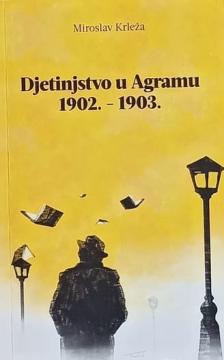
Djetinjstvo u Agramu 1902.-1903.
Childhood in Agram 1902–1903 is an autobiographical account in which Krleža depicts Zagreb at the turn of the century through scenes from his childhood: a city of contrasts, social differences, school fears, and the first insights into the adult world.
In “Childhood in Agram 1902–1903.” Miroslav Krleža returns to his early childhood to evoke a multi-layered, emotional and often dark Zagreb – Agram – from the time of the Austro-Hungarian Monarchy. It is an autobiographical fragment that simultaneously functions as a personal memory and a critical image of the society in which the writer grew up. Krleža does not romanticize childhood: he observes it from the perspective of an adult who knows well how early children are exposed to hierarchies, fears and pressures from their environment.
The scenes he describes range from home habits and family upbringing to the streets of Agram – muddy, cold, strictly divided according to class. School takes center stage: Krleža evokes an atmosphere of strict discipline, authoritative teachers and fear of rules that children had to accept without understanding. Through the eyes of children, it depicts the first encounter with injustice, social differences and the provincial spirit of an environment that presents itself as “moral” and is at the same time imbued with hypocrisy.
The description of the city and its people is by no means merely factual. Krleža’s Agram is a living organism: summer heat, foggy mornings, city cafes, military everyday life, kiosks, trams and the oriental scents of street shops form a mosaic of a city that pulsates between the old and the new, between imperial uniforms and local rebellious energy. Within this framework, little Miroslav discovers his first literary impulses, the first visual impressions that will later mark his artistic sensibility.
The central value of this text lies in the layered mixture of intimacy and social analysis. As he recounts his childhood, Krleža clearly shows where his later critical awareness comes from: from the experience of an unjust school system, from encounters with militarized everyday life, from an awareness of social differences that were already very much felt at an age when a child should live only in play and imagination.
Childhood in Agram 1902–1903 thus becomes more than an autobiographical fragment – it is a picture of a city, a time, and the genesis of a strong literary consciousness, written in Krleža's dense, impressive, and emotionally charged style.
One copy is available