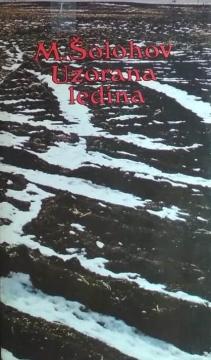
Uzorana ledina

Uzorana ledina

Mihail Šolohov

The novel is set in a Cossack community on the Don River during collectivization in the Soviet Union. The work, divided into two parts, follows the dramatic changes in the village of Gremyachi Log as the Bolsheviks introduce collective farms, which provok

The main character, Semyon Davydov, a former sailor and communist, arrives in the village to implement collectivization. His idealism clashes with the traditional Cossack way of life. He is aided by Nagulnov, a fanatical Bolshevik, and Razmetnov, a more moderate communist. Local Cossacks, such as Yakov Ostrovnov, vacillate between adaptation and resistance, while the kulaks (the wealthier peasants) actively sabotage the reforms. The novel depicts conflict, intrigue, and violence, including murder and betrayal, as the village struggles with the new order.

Sholokhov paints a detailed picture of Cossack life—customs, work in the fields, love affairs—along with political tensions. Davydov falls in love with Louisa, the kulak's ex-wife, further complicating his mission. The novel explores moral dilemmas, sacrifice, and the conflict between the old and new worlds. As collectivization progresses, many characters suffer tragically, and the village is irrevocably changed.

"The Ploughed Meadow" is a realistic depiction of a historical turning point, with an emphasis on human passions and conflicts. Sholokhov masterfully combines epic storytelling with psychological depth, making the novel a powerful testimony to a turbulent period.

Original title
Поднятая целина
Translation
Nada Cekić
Editor
Nikica Petrak
Graphics design
Alfred Pal
Dimensions
21 x 13 cm
Pages
765
Publisher
Sveučilišna naklada Liber (SNL), Zagreb, 1980.
 
Latin alphabet. Hardcover with dust jacket.
Language: Croatian.

No copies available

The last copy was sold recently.
 

Are you interested in another book? You can search the offer using our search engine or browse books by category.

You may also be interested in these titles

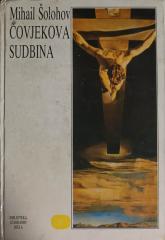
Čovjekova sudbina

Čovjekova sudbina

Mihail Šolohov
Svjetlost, 1988.
Croatian. Latin alphabet. Hardcover.
4.99
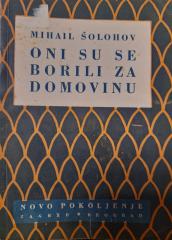
Oni su se borili za domovinu

Oni su se borili za domovinu

Mihail Šolohov
Novo pokoljenje, 1947.
Croatian. Latin alphabet. Paperback.
6.24
Oni su se borili za domovinu

Oni su se borili za domovinu

Mihail Šolohov

The novel follows a group of Soviet soldiers during their retreat in 1942. Through their struggles, fear, humor, and togetherness, Sholokhov depicts the reality of war, human endurance, and moral strength despite defeat.

Svjetlost, 1979.
Croatian. Latin alphabet. Hardcover.
4.22 - 4.86
Selo Stepančikovo

Selo Stepančikovo

Fjodor Mihajlovič Dostojevski

"The Village of Stepanchikovo" is a humorous novel by Dostoyevsky, first published in 1859. This novel, which differs from the later, darker works of the author, is a satirical critique of social relations and human weaknesses.

Svjetlost, 1962.
Serbian. Latin alphabet. Paperback.
4.22 - 4.76
Džingis-kan

Džingis-kan

Vasilij Jan

Vasily Yan's novel Genghis Khan depicts the rise of the Mongol leader Temujin, from childhood in the steppes to the creation of the largest empire in the world, highlighting his courage, cruelty, and relentless will to power.

Rad, 1988.
Serbian. Latin alphabet. Hardcover.
9.78
Roman s kokainom

Roman s kokainom

Mihail Agejev

A novel with cocaine is a psychological prose in which the narrator Vadim Maslenikov presents his "case" of moral and physical decay during the turbulent years of Russian history. Mihail Ageyev is the pseudonym of Mark Levi.

Gradac, 1987.
Serbian. Latin alphabet. Paperback with dust jacket.
8.24