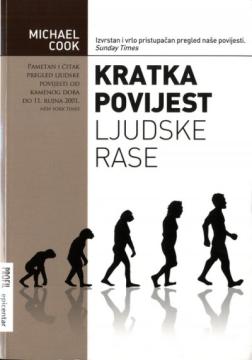
Kratka povijest ljudske rase

Kratka povijest ljudske rase

Michael Cook

Michael A. Cook, Princeton professor of Islamic history, provides an overview of human history from the Neolithic to the fall of the Twin Towers in 2001 in this witty and intelligent synthesis, asking the key question: why did everything happen exactly th

Instead of linear storytelling, Cook jumps through eras, emphasizing the eccentric diversity and gradual unification of human culture - from the agricultural revolution that gives birth to civilizations, through empires (Egypt, China, Rome, Islam), to European expansion and modern globalism.

The book is divided into thematic sections: demography, technology, religion and politics as drivers of change. Cook emphasizes coincidences and inevitable trends - why did Europe dominate and Asia lag behind? – using examples such as the Mongol conquests, the Islamic Golden Age and industrial capitalism. With irony and depth, he analyzes how disease, trade and ideas connected the continents, creating a "single" race in the midst of chaos.

It is a work of dense ideas, ideal for those who want a global view without dryness - short but deep, it reminds us that the human story is a story of resilience and contradictions.

Original title
A Brief History of Human Race
Translation
Ivan Buljan
Editor
Stjepan Ravić
Dimensions
21 x 15 cm
Pages
414
Publisher
Profil Knjiga, Zagreb, 2009.
 
Latin alphabet. Paperback.
Language: Croatian.

One copy is available

Condition:Used, excellent condition
 

Are you interested in another book? You can search the offer using our search engine or browse books by category.

You may also be interested in these titles

Ciklus svemirskih katastrofa: Potopi, požari i skapavanja u povijesti civilizacije

Ciklus svemirskih katastrofa: Potopi, požari i skapavanja u povijesti civilizacije

Richard Firestone, Allen West, Simon Warwick-Smith

The book is the most readable and complete overview of the evidence that human civilization has already been nearly wiped out of the universe once – and that such cycles may repeat themselves every few tens of thousands of years.

Stari grad, 2007.
Croatian. Latin alphabet. Hardcover.
21.2214.94 - 21.3421.28
Otkriće Indije

Otkriće Indije

Jawaharlal Nehru

The Discovery of India, written in 1946 during Nehru's time in prison, is a monumental work that explores the history, culture, and spirit of India. Nehru, a key figure in the Indian independence movement, writes about the past and with a vision for the n

Rad, 1952.
Serbian. Latin alphabet. Hardcover with dust jacket.
9.46
Tutankhamon: Kralj u zlatnim kovčezima

Tutankhamon: Kralj u zlatnim kovčezima

Otto Neubert

The author, one of the living eyewitnesses of the excavations in the Valley of the Kings, provides the reader with a popular-scientific picture not only of one of the most famous ancient Egyptian rulers, but also of the most interesting facts of the ethno

Stvarnost, 1977.
Croatian. Latin alphabet. Hardcover.
8.56
Waging War: Conflict, Culture, and Innovation in World History

Waging War: Conflict, Culture, and Innovation in World History

Wayne E. Lee
Oxford University Press, 2015.
English. Latin alphabet. Paperback.
36.22
Zagonetka podunavske civilizacije

Zagonetka podunavske civilizacije

Harald Haarman

Harald Haarmann's book presents the discovery of Europe's oldest highly developed culture (c. 5500–3500 BC), known as the Danube or Old European Civilization, with an emphasis on its writing, art and influence.

Akademska knjiga, 2019.
Croatian. Latin alphabet. Paperback.
27.00
Izabrani Plinijevi listovi

Izabrani Plinijevi listovi

Plinije Stariji

Anthology of Latin Fragments of Pliny the Elder with Croatian Explanations (Golik, 1909) presents ancient views on nature, man and the world, with brief comments for understanding and teaching.

Troškom i nakladom Kr. hrv.-slav.-dalm. zemalj. vlade, 1909.
Latin. Latin alphabet. Paperback.
9.32