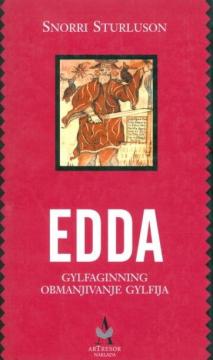
Edda Gylfaginning / Obmanjivanje Gylfija

Edda Gylfaginning / Obmanjivanje Gylfija

Snorri Sturluson

Within medieval European literature, Snorra Edda occupies a particularly significant position, as it represents the only attempt at a systematic presentation of mythological tradition on our continent.

Apart from this North Germanic mythology, nothing similar exists in either the ancient or medieval literature of other European peoples. Snorri's Edda consists of a Prologue and three main parts: Gylfaginning (The Deception of Gylfi), Skáldskaparmál (The Word of Poetry), and Háttatal (The List of Verses). In the Prologue, Snorri presents his view of the mythological material he wishes to narrate, and the first part of the Edda (The Deception of Gylfi) is a concise account of North Germanic mythology, from the creation of the world, through stories from the lives of the gods, to their final doom, Ragnarök. The narrative framework in the part of the Edda entitled Gylfaginning (The Deception of Gylfi) is a sketch of the mythical Swedish king Gylfi, a representative of the ancient inhabitants of the European north, wise and versed in spells. Disguised and under the name of Gangleri ("he who walks"), Gylfi travels to Asgard ("the world of Asa") to meet the Aes and learn their wisdom and magic, and create a bond between them and his There, in the court, he meets the gods who answer his questions about the creation and destruction of the world, about the gods and their deeds, so they get rid of Gangleri, who unexpectedly finds himself in the field from which the courts and the gods have disappeared. But what Gangleri experienced and heard was still recounted in his country.

Titel des Originals
Edda Gylfaginning og prosafortellingene av skaldskaparmal
Übersetzung
Dora Maček
Editor
Bojan Marotti
Titelseite
Ivica Belinić
Maße
21 x 13 cm
Seitenzahl
187
Verlag
ArTresor naklada, Zagreb, 1997.
 
Auflage: 1.000 Exemplare
 
Latein Schrift. Taschenbuch.
Sprache: Kroatisch.

Angeboten wird ein Exemplar

Zustand:Gebraucht, in ausgezeichnetem Zustand
Zum Warenkorb hinzugefügt!
 

Interessieren Sie sich für ein anderes Buch? Sie können das Angebot über unsere Suchmaschine suchen und finden oder Bücher nach Kategorien durchsuchen.

Diese Titel könnten Sie auch interessieren

Proces

Proces

Franz Kafka

Kafka wrote The Process between 1914 and 1915, published posthumously in 1925. The novel is unfinished but with an added final chapter by Max Brod. Edition with a foreword by B. Živojinović and an afterword by Walter Killi.

BIGZ, 1990.
Serbisch. Latein Schrift. Taschenbuch.
4,26
Malena je ime tanga

Malena je ime tanga

Almudena Grandes

If you like raw eroticism like Cloud Atlas, this is a sensual saga – emotional, provocative, for those who want to feel the pulse of forbidden passion! Grandes probes whether love is a curse or a liberation?

Mozaik knjiga, 2000.
Kroatisch. Latein Schrift. Hardcover.
8,54
Amandino vjenčanje

Amandino vjenčanje

Jenny Colgan

A romantic comedy about friendship, love, and the chaotic attempts to save a good man from a bad marriage. A chick-lit hit, it reminds us that friendship saves more than any plan, and love comes unexpectedly.

Znanje, 2001.
Kroatisch. Latein Schrift. Taschenbuch.
5,36
Zagrepčanka

Zagrepčanka

Branislav Glumac

Branislav Glumac published a novel without periods or commas in 1974, as the relentless stream of thought of a young rebel. Published in socialist Yugoslavia, the work caused a scandal with its openness and became a classic about generational rebellion.

IROS, 1986.
Kroatisch. Latein Schrift. Hardcover.
8,24
Eva Luna

Eva Luna

Isabel Allende

Eva Luna is a novel about a poor storyteller who weaves lives with words, written by Isabel Allende, the founder of Latin American magical realism. Published after the success of The House of the Spirits, this whirlwind of adventure combines love, revolut

Znanje, 1990.
Kroatisch. Latein Schrift. Fester Einband mit Schutzumschlag.
8,36
I ne reče ni reči

I ne reče ni reči

Heinrich Böll

In Boll's novels, one of the central themes is the attempt to preserve basic moral values ​​in a time of terror, as well as in a period of material prosperity and corruption.

Svjetlost, 1965.
Serbisch. Latein Schrift. Taschenbuch.
3,22 - 3,98