Proljetne vode
Rare book

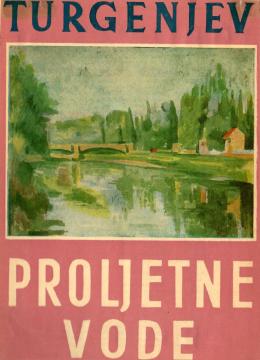
Proljetne vode

I. S. Turgenjev

Spring Waters (1872) is a lyrical novel about first love, the transience of youth, and the impossibility of man to love without losing his innocence or freedom. A classic work of Russian realism about love that changes life but does not save it.

The story takes place in two times: in the 1840s in Germany and 20 years later in Russia. The main character, Dmitry Pavlovich Sanjin (or Sanin), a young Russian nobleman, travels through Europe and in Frankfurt (or Mainz) he meets the Italian Roselli family: the beautiful 19-year-old Gemma, her widowed mother and younger brother Emanuel. Gemma is engaged to a rich German man, Klüber, but Sanjin falls in love with her, and she with him. After dramatic events (a duel, the breakup of the engagement), Sanjin proposes to her and gets her consent.

However, love does not come true: Sanjin meets Maria Nikolaevna Polozova, a rich, seductive and manipulative widow who seduces him and drags him into a passionate adventure. Sanjin betrays Gemma, loses her forever and remains trapped in an empty, rich life with Maria – a symbol of slavery to passions and the loss of youthful purity.

The novel is introspective, melancholic, and autobiographical (Turgenev draws from his own experiences). The theme is the transience of the spring waters of youth: love is strong but short-lived, and man is left alone with the memory of what he could have had.

Original title
Вешние воды
Translation
Miloš Moskovljević
Editor
Ivan Fogl
Illustrations
Paul Cezanne
Graphics design
Bravo Muhamed
Pages
160
Publisher
Narodna prosvjeta, Sarajevo, 1954.
 
Latin alphabet. Hardcover with dust jacket.
Language: Croatian.

No copies available

The last copy was sold recently.
 

Are you interested in another book? You can search the offer using our search engine or browse books by category.

You may also be interested in these titles

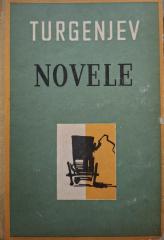
Novele

Novele

I. S. Turgenjev

Three Portraits, Three Meetings, Mumu, The Inn, The Lee's Gate, The Song of Triumphal Love, Brigadier, Steppe King Lear, The Road to Polesie, Asya, First Love

Zora, 1950.
Croatian. Latin alphabet. Hardcover.
6.96
Dok ležah na samrti

Dok ležah na samrti

William Faulkner

Faulkner's 1930 novel, a classic example of modernist literature. It is often compared to Joyce's "Ulysses" for its innovative structure, but is more accessible due to its focus on family.

Rad, 1985.
Croatian. Latin alphabet. Paperback.
3.26
Kreutzerova sonata, Hadži-Murat

Kreutzerova sonata, Hadži-Murat

Lav Nikolajevič Tolstoj

Kreutzer's sonata belongs to those works of Tolstoy that the writer adapted in many ways to his view on moral issues, on marital morality above all.

Civitas, 2004.
Croatian. Latin alphabet. Paperback.
4.98
Amandino vjenčanje

Amandino vjenčanje

Jenny Colgan

A romantic comedy about friendship, love, and the chaotic attempts to save a good man from a bad marriage. A chick-lit hit, it reminds us that friendship saves more than any plan, and love comes unexpectedly.

Znanje, 2001.
Croatian. Latin alphabet. Paperback.
5.36
Zagrepčanka

Zagrepčanka

Branislav Glumac

Branislav Glumac published a novel without periods or commas in 1974, as the relentless stream of thought of a young rebel. Published in socialist Yugoslavia, the work caused a scandal with its openness and became a classic about generational rebellion.

IROS, 1986.
Croatian. Latin alphabet. Hardcover.
8.22 - 8.24
Rudnik čvaraka

Rudnik čvaraka

Tomislav Šovagović

The debut work of Croatian writer Tomislav Šovagović, awarded the Josip and Ivan Kozarac Award in 2012, is a dedication to Slavonia – the region of his childhood that the author, born in Dalmatia, observes with foreign but tender eyes.

Mozaik knjiga, 20112.
Croatian. Latin alphabet. Paperback.
11.568.09