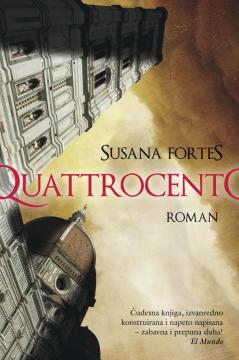
Quattrocento

Quattrocento

Susana Fortes

A double story: Florence 1478, the Pazzi conspiracy against the Medici. In the 21st century, student Ana Sotomayor investigates Renaissance painter Pierpaolo Masoni and his enigmatic painting - uncovering the hidden truth about the conspiracy and its cons

Quattrocento by Susana Fortes (b. 1956, Galician writer, known for El amante albanés) is a mix of historical novel, thriller and art fiction. The novel takes place in two times:

In 15th-century Florence (the Renaissance era of Botticelli and Leonardo), it describes the famous Pazzi conspiracy on April 26, 1478 – the assassination of the Medici brothers in the Cathedral of Santa Maria del Fiore. Giuliano de' Medici is killed, Lorenzo survives, and Florence sinks into revenge, torture and persecution. Pope Sixtus IV, the Pazzi family and King Ferdinand of Naples pull the strings in the background, wanting to overthrow the Medici power.

In the contemporary part (21st century), a young doctoral student Ana Sotomayor is writing a dissertation on the Renaissance painter Pierpaolo Masoni, a lesser-known artist. Studying his notebooks and the enigmatic painting, Ana discovers that Masoni was not just a painter – he may have been a key witness or participant in a conspiracy, and his work hides a secret that changes official history. The more she digs, the more she realizes that the discovery could have dangerous consequences in modern-day Florence – perhaps even endangering her life.

Fortes uses a style similar to Dan Brown (but criticizes it within the text as "modern superstition"), with an emphasis on historical accuracy, artistic detail, political intrigue and suspense. The two lines develop in parallel, building tension through revelations, secrets and moral dilemmas. Criticism is divided: some praise the ambition and Florentine setting, others criticize the excessive twists and "Chekhov's guns" that do not fire.

Translation
Silvana Roglić
Editor
Iva Karabaić Kraljević
Dimensions
19 x 12.3 cm
Pages
292
Publisher
Fraktura, Zaprešić, 2010.
 
Latin alphabet. Paperback.
Language: Croatian.

Two copies are available

Copy number 1

Condition:Used, excellent condition

Copy number 2

Condition:Used, excellent condition
 

Are you interested in another book? You can search the offer using our search engine or browse books by category.

You may also be interested in these titles

Vojske

Vojske

Evelio Rosero

A poignant novel about Ismael and his wife Otilia in the Colombian village of San José, which is slowly being destroyed by various armies – guerrillas, paramilitaries, the army and drug gangs. A powerful portrayal of the senselessness of civil war and the

Hena Com, 2021.
Croatian. Latin alphabet. Hardcover with dust jacket.
8.44
2666

2666

Roberto Bolaño

A tour de force though the phrase seems hardly adequate to describe the novel's narrative velocity, polyphonic range, inventiveness, and bravery. NYR

Picador, 2008.
English. Latin alphabet. Hardcover with dust jacket.
14.3210.74
Hitar kao žudnja

Hitar kao žudnja

Laura Esquivel

This sensual and emotional story explores the complex relationships of love, communication, and family ties through the life story of Júbilo, a man gifted with the exceptional gift of understanding and conveying emotions.

Algoritam, 2005.
Croatian. Latin alphabet. Paperback.
3.24
Eva Luna

Eva Luna

Isabel Allende

Eva Luna is a novel about a poor storyteller who weaves lives with words, written by Isabel Allende, the founder of Latin American magical realism. Published after the success of The House of the Spirits, this whirlwind of adventure combines love, revolut

Znanje, 1990.
Croatian. Latin alphabet. Hardcover with dust jacket.
8.36
Zla kob

Zla kob

Gabriel Garcia Marquez

The novel is told as a journalistic reconstruction of the murder of Santiago Nasar. The story takes place in a small Caribbean town, where everyone knows in advance that Santiago will be killed by the Vicario brothers – Pedro and Pablo – in order to defen

V.B.Z, 2005.
Croatian. Latin alphabet. Paperback.
4.96
Dvanaest hodočasnika

Dvanaest hodočasnika

Gabriel Garcia Marquez

A collection of twelve short stories by the Colombian Nobel laureate, written during 18 years of exile in Europe. Márquez's magical realism here describes exile as a pilgrimage – a journey towards oneself in a foreign land, where the miraculous hides in t

V.B.Z, 2006.
Croatian. Latin alphabet. Paperback.
4.86