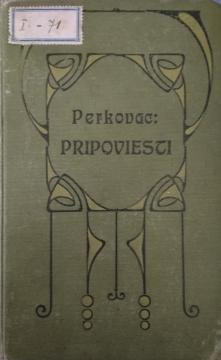
Pripoviesti: Iz bojnoga odsjeka
A collection of short stories that realistically and patriotically portrays life and events from the period of absolutism and the Bach regime, the military administration, Croatian officers, ordinary people and their fates in difficult times.
Ivan Perkovac (1826–1871), a Croatian writer, publicist, editor and politician from the era of the Illyrian movement and absolutism, is the author of the collection Pripoviesti – Iz bojnoga odsjeka. The book was published posthumously in 1905 by Matica hrvatska in Zagreb. It contains a selection of his stories and sketches that had previously appeared in magazines (most notably in Vienca), and along with the texts, it also includes a biography of Ivan Perkovac written by Dr. Ivan Zahar, and a picture of Perkovac.
Perkovac worked in the Military Department of the Ban's Council, so many of his stories are autobiographical and based on direct knowledge of military administration, bureaucracy and everyday life in Croatia under Austrian absolutism (1850s). His best-known stories are Stankovačka učiteljica, Crtice iz bojnoga odsjeka, Upnikova's sister and Šljivari. He writes realistically, with an emphasis on social conditions, the national question, the suffering of the common man and Croatian patriotism.
His style is simple, lively and humorous-satirical in depicting bureaucratic absurdities, but also warm when describing ordinary people. Perkovac belongs to the generation of writers who, after Illyrianism, moved to a realistic depiction of society, and his stories are considered an important step in the development of Croatian realistic prose of the 19th century.
The 1905 edition has a special value because it brings together scattered texts and brings an extensive biography by Zahar, which describes in detail Perkovac's turbulent life - from dropping out of the seminary, working in the military administration, studying law, working as a journalist (editor of Pozora and Vienca), his parliamentary mandate, to his premature death in Samobor in 1871.
Today, the work is a rare antiquarian edition and an important document of Croatian literature and social conditions in the second half of the 19th century.
One copy is available