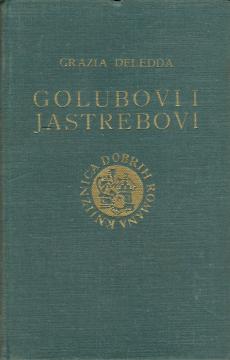
Golubovi i jastrebovi
Rare book
Antique

Golubovi i jastrebovi

Grazia Deledda

In a typically Sardinian setting, through a dramatic love story, Deledda depicts the conflict between two families and their worlds – the peaceful, honest "doves" and the aggressive, greedy "hawks".

Grazia Deledda (1871–1936), an Italian writer of Sardinian origin and winner of the Nobel Prize for Literature in 1926, wrote the novel Colombe e sparvieri, set in rural Sardinia, in a world of old customs, blood feuds and deep social divisions. The novel contrasts two families: one peaceful, virtuous and almost patriarchally ideal (the “doves”), and the other aggressive, powerful and ruthless (the “hawks”). Through the central love story, Deledda masterfully depicts the conflict between good and evil, passion and duty, revenge and forgiveness.

As in most of her works, Deledda here emphasizes the power of the Sardinian landscape, which becomes an almost fateful force in the lives of the characters. The novel is rich in psychological portraits, especially of the female characters, and in subtle analysis of internal conflicts and moral dilemmas. The style is realistic with lyrical and symbolic elements, typical of Deledda's verismo inspired by Sardinian tradition and folklore.

In the Croatian reception in 1931, the novel was very well received as a quality European fiction with strong ethical and psychological depths. Today, Golubovi i jastrebovi is considered one of Deledda's representative novels from her mature period, although it is not among the most famous like Canne al vento or La Madre. It remains a valuable read for fans of regional realism and the literature of Nobel laureates.

The antiquarian edition from 1931 is rare.

Original title
Colombi e sparvieri
Translation
Luka Perinić, Marinko Scattolini
Dimensions
19 x 12.5 cm
Pages
260
Publisher
Hrvatsko književno društvo Sv. Jeronima, Zagreb, 1931.
 
Latin alphabet. Hardcover.
Language: Croatian.

One copy is available

Condition:Used, excellent condition
 

Are you interested in another book? You can search the offer using our search engine or browse books by category.

You may also be interested in these titles

Sandokan

Sandokan

Emilio Salgari, Renato Caporali

A free prose adaptation by Renato Caporali based on the screenplay of the Italian mini-series Sandokan (1976, directed by Sergio Sollim, starring Kabir Bedi). It is based on the novel of the same name by Emilio Salgari (I pirati della Malesia, 1896).

Globus, 1977.
Croatian. Latin alphabet. Hardcover.
14.38
Pustolovine u samostanu: priče iz Dekamerona

Pustolovine u samostanu: priče iz Dekamerona

Giovanni Boccaccio

In this humorous and satirical story, Boccaccio depicts life in a monastery and ridicules the hypocrisy and weaknesses of people who should live morally and piously.

Naprijed, 1964.
Croatian. Latin alphabet. Paperback.
3.00
Ravnodušni ljudi

Ravnodušni ljudi

Alberto Moravia

The novel follows the declining Roman bourgeois family of Ardengo over the course of several days: widow Mariagrazia, lover Leo, son Michele, and daughter Carla – all trapped in apathy, lies, sexual manipulation, and moral indifference.

Otokar Keršovani, 1966.
Croatian. Latin alphabet. Hardcover.
3.22
Drugi kraj konca

Drugi kraj konca

Andrea Camilleri

The Other End (2016) is part of the Inspector Salvo Montalbano series. Set in the fictional Sicilian town of Vigàtu, the novel combines criminal intrigue with the current topic of the migration crisis, with Camilleri's signature humor.

Profil Knjiga, 2017.
Croatian. Latin alphabet. Paperback.
8.34
Jedna žena… Mnoge žene…

Jedna žena… Mnoge žene…

Luisa Nemez

The character of the main heroine of this novel reflects the efforts of a woman who expects a lot from life, love, and career.

Stoma medical, 2002.
Croatian. Latin alphabet. Paperback.
2.98
Konformist

Konformist

Alberto Moravia

Marcello Clerici, obsessed with normality after a traumatic childhood and a homosexual attack, becomes a fascist bureaucrat. He marries the average Giulia, and on their "honeymoon" in Paris, he is assigned to kill a former professor, anti-fascist Quadri.

Otokar Keršovani, 1966.
Croatian. Latin alphabet. Paperback.
4.96