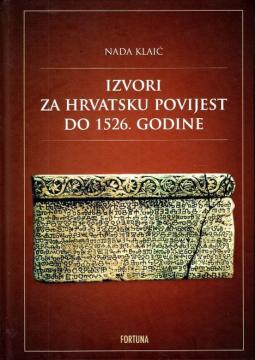
Izvori za hrvatsku povijest do 1526. godine
The work presents key narrative and diplomatic sources for Croatian history up to 1526, with a critical analysis of their reliability, context, and interconnections, and emphasizes the development of Croatian political structures throughout the Middle Age
Sources for Croatian History to 1526 by Nada Klaić systematically gathers and analyses the main narrative, legal, epigraphic and diplomatic sources for the earliest periods of Croatian history. The author provides an overview of Frankish and Byzantine accounts of early Croatian statehood, including the works of Constantine Porphyrogenitus, Frankish annals and papal writings, highlighting their importance, but also the problems of fragmentation, political bias and later interpolations.
Klarić then examines domestic sources from the 11th century onwards: chronicles, genealogies, annals and legal documents that shed light on the development of the Croatian kingdom, relations with Hungary and the gradual formation of noble structures. She particularly highlights the Povalj Charter, the Vinodol Law, documents of Croatian-Hungarian rulers and the communal statutory tradition of Dalmatian towns. The analysis focuses on the transfer of power, the role of nobles, the process of feudalisation and the formation of territorial organisation.
The third part of the book is devoted to the original material that traces the political and social changes in the late Middle Ages, including the Ottoman invasions, the reshaping of the defense system, and the strengthening of local autonomies. The author emphasizes the importance of archival funds in Zagreb, Zadar, Trogir, Split, and Dubrovnik, as well as European archives that preserve key documents about Croatian rulers and diplomacy.
The book does not only provide a list of sources but also their critical interpretation. Klaić points out the methodological challenges of historical research: problems of authenticity, dating, transcription, and later alterations, and the need for a comparative analysis of different traditions in order to reconstruct early political processes. The result is a thorough review of the material necessary for understanding Croatian history up to the Battle of Mohács.
One copy is available