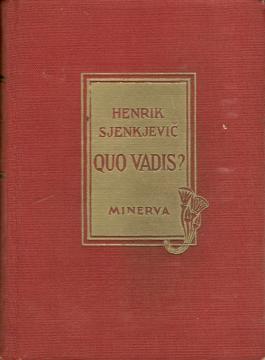
Quo Vadis?

Quo Vadis?

Henryk Sienkiewicz

Rome during the reign of Emperor Nero. The young patrician Marcus Vinicius falls in love with the Christian Lygia. Amidst the persecution of Christians and the Great Fire of Rome, their love becomes a symbol of faith, sacrifice, and salvation.

Quo Vadis? (1896) is a masterpiece by Henryk Sienkiewicz, a Polish Nobel Prize winner and one of the most famous historical novels in world literature. The title comes from the legend of the meeting of the apostle Peter with Jesus Christ outside Rome, to the question: “Quo vadis, Domine?” (“Where are you going, Lord?”).

The plot is set in Rome during the reign of Emperor Nero (1st century AD 60s). The young and ambitious Roman patrician Marcus Vinicius falls in love with a beautiful but Christian girl Lygia. This love changes his entire life. Through Vinicius’s eyes, the reader enters the luxurious, decadent and cruel world of Nero’s Rome – orgies, gladiatorial fights, intrigue and boundless tyranny.

Sienkiewicz masterfully contrasts two worlds: pagan Rome, full of power, violence and moral decay, and the early Christian community – modest, pure and ready for martyrdom. Great characters such as the apostle Peter, St. Paul, the cruel Tigellinus and the madman Nero come to life on the pages of the novel.

The novel abounds in spectacular scenes: the fire of Rome, the persecution of Christians, fights in the arena, but also deep spiritual and love dramas. Sienkiewicz wrote the work with exceptional erudition, using historical sources (Tacitus, Suetonius), and at the same time created an exciting, emotional and deeply religious story.

Quo Vadis? was a world bestseller in the late 19th and early 20th centuries, translated into dozens of languages ​​and filmed several times (the most famous version from 1951 with Robert Taylor and Deborah Kerr).

Translation
Lazar R. Knežević
Editor
Tanasije Mladenović
Illustrations
Nada Doroški
Graphics design
Stevan Vujkov
Dimensions
20 x 14 cm
Pages
572
Publisher
Minerva, Subotica, 1958.
 
Latin alphabet. Hardcover.
Language: Serbian.

One copy is available

Condition:Used, excellent condition
 

Are you interested in another book? You can search the offer using our search engine or browse books by category.

You may also be interested in these titles

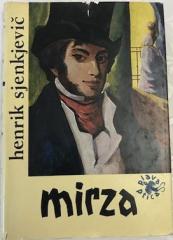
Mirza

Mirza

Henryk Sienkiewicz
Mlado pokolenje, 1967.
Serbian. Latin alphabet. Hardcover with dust jacket.
3.98 - 3.99
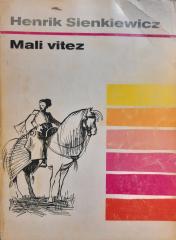
Mali vitez

Mali vitez

Henryk Sienkiewicz
Mladinska knjiga, 1974.
Slovenian. Latin alphabet. Paperback.
3.84
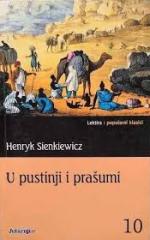
Kroz pustinju i prašumu

Kroz pustinju i prašumu

Henryk Sienkiewicz

An adventure story set in Africa at the end of the 19th century. It follows the fate of two young protagonists, 14-year-old Pole Stas Tarkowski and 8-year-old Englishwoman Nel Rawlison, who are kidnapped by Sudanese robbers in colonial Egypt.

Rad, 1986.
Serbian. Latin alphabet. Hardcover.
4.20
Noć

Noć

Edgar Hilsenrath

A poignant novel describing life in a Jewish ghetto in Ukraine, based on the author's experience as a Holocaust survivor. Set in the fictional town of Prokov, the novel follows the inhabitants of the ghetto, especially Raneko, as they struggle to survive.

August Cesarec, 1982.
Croatian. Latin alphabet. Hardcover with dust jacket.
6.58
Mi, djeca Solferina

Mi, djeca Solferina

Maroje Mihovilović

Maroje Mihovilović, a Croatian journalist and writer, creates a fascinating, true family saga in his novel We, the Children of Solferino that follows five generations of the Mihovilović-Vukelić family from the end of the 17th century to the turbulent 20th

Profil Knjiga, 2017.
Croatian. Latin alphabet. Hardcover with dust jacket.
31.26
Armageddon

Armageddon

Leon Uris

Armageddon (1964) by Leon Uris is a historical novel set in post-war Berlin during the 1948-1949 airlift, when the Allies supplied West Berlin amidst the Soviet blockade.

Otokar Keršovani, 1970.
Croatian. Latin alphabet. Hardcover with dust jacket.
8.26