Gedichte: Aus dem Alltag
Rare book
Antique

Gedichte: Aus dem Alltag

Otto Müller-Neudorf

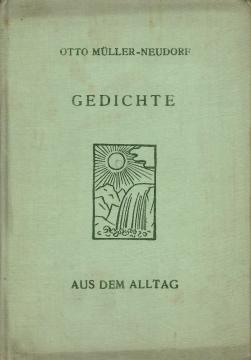
Gedichte: Aus dem Alltag (Zagreb, 1942) is a collection of lyrical poems in German by Otto Müller-Neudorf inspired by everyday life. Published in the NDH, it reflects intimate observations, nature, and everyday moments.

Gedichte: Aus dem Alltag (Poems: From Everyday Life) is a collection of poetry by the German author Otto Müller-Neudorf published in Zagreb in 1942. It is a relatively thin collection of lyrical poems written in German, which draw inspiration from ordinary, everyday life – from natural motifs, city scenes and intimate moments to reflections on the transience and beauty of the ordinary.

Müller-Neudorf was a German writer, translator and cultural activist who lived in the Balkans for a long time. He is best known for his anthology of Bulgarian literatureBlumen aus dem Balkan (1917), but he lived in Zagreb during World War II, where he also published this collection. The poems are mostly of traditional form, melodic and introspective, without strong ideological or propaganda elements, which was unusual for German-language production in the NDH at that time.

The collection reflects the author's attempt to find lyrical peace in everyday life during wartime. The style is close to late Romanticism and Impressionism, with an emphasis on image, atmosphere and inner experience. Today, this edition is a rarity and represents an interesting example of German literary activity in Zagreb during the Independent State of Croatia. The book was printed in a small publishing house and bears witness to the cultural ties between the German language and the Croatian space during that turbulent period.

Dimensions
18.5 x 12.5 cm
Pages
60
Publisher
Vlastita naklada, Zagreb, 1942.
 
Latin alphabet. Hardcover.
Language: German.

One copy is available

Condition:Used, very good condition
Damages or inconvenience notice:
  • Pencil notes
 

Are you interested in another book? You can search the offer using our search engine or browse books by category.

You may also be interested in these titles

I ne reče ni reči

I ne reče ni reči

Heinrich Böll

In Boll's novels, one of the central themes is the attempt to preserve basic moral values ​​in a time of terror, as well as in a period of material prosperity and corruption.

Svjetlost, 1965.
Serbian. Latin alphabet. Paperback.
3.22 - 3.98
Najljepše priče klasične starine

Najljepše priče klasične starine

Gustav Schwab

Schwab's work restores and develops a sense of the value of antiquity, that inexhaustible source of folk fantasy that seeks to interpret and explain the world with the original poetic power recognized in the traditions of ancient man.

Grafički zavod Hrvatske (GZH), 1989.
Croatian. Latin alphabet. Hardcover.
The book consists of 3 volumes
5.25
Na Rio de la Plati

Na Rio de la Plati

Karl May

The novel On the Rio de la Plata is the first part of a two-part adventure story by Karl May, continued in In the Cordilleras. The action takes place in South America, in Uruguay and Argentina, during the revolutionary turmoil of the 19th century.

Stvarnost, 1964.
Croatian. Latin alphabet. Hardcover.
5.38 - 6.84
Kao suza u okeanu I-II

Kao suza u okeanu I-II

Manes Sperber

A trilogy by Austrian-French writer and psychologist Manès Sperber, which, through three novels – "Dust and Ashes", "In the Vortex" and "Memories and Shadows" – explores the themes of totalitarianism, ideological blindness and human suffering during the t

Matica srpska, 1997.
Serbian. Cyrillic alphabet. Paperback.
The book consists of two volumes
9.38
Karlo i XX. stoljeće

Karlo i XX. stoljeće

Rudolf Brunngraber

The story of Karl Lakner, caught in the huge world machine of capitalism. A political and economic visionary novel by Rudolf Brunngraber from the 1930s.

Naklada Binoza, 1939.
Croatian. Latin alphabet. Hardcover with dust jacket.
9.56 - 37.42
Noć

Noć

Edgar Hilsenrath

A poignant novel describing life in a Jewish ghetto in Ukraine, based on the author's experience as a Holocaust survivor. Set in the fictional town of Prokov, the novel follows the inhabitants of the ghetto, especially Raneko, as they struggle to survive.

August Cesarec, 1982.
Croatian. Latin alphabet. Hardcover with dust jacket.
6.58