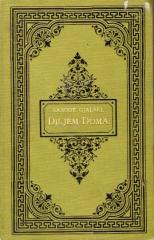
U žutoj kući
Gjalski's novel In the Yellow House (1914) exposes provincial everyday life: masks of politeness, quiet ambitions, and gentle, ironic clashes between desire and duty, told with fine psychology and style. Rare antiquarian edition.
Welcome to the Yellow House by Ksaver Šandor Gjalski — an address where a whisper has the same weight as a scream. Here, carriages are not chased or empires fall; the drama unfolds in the living room, between the lines, in a look that lasts a second too long. Gjalski takes us through the living rooms of a small town, where “what will people say” shapes other people’s lives, and petty vanities and great hopes live under the same roof. The characters are subtly nuanced: someone would like to go beyond the town limits, someone just wants peace, and someone else confirmation that they are important. And when, seemingly, nothing is happening — in fact, everything is happening: illusions are being worn out, duties are pressing, and the heart is whispering its own.
The prose is elegant and transparent: sentences flow calmly, and beneath them flickers an irony that never stings, only reveals. The psychological profile of each character grows from small things: a silently closed door, an absent smile, an interrupted sentence. The composition is measured, the pace is even, and the atmosphere is as dense as the afternoon air in a drawing room. For the reader, this means a novel that is not won over by noise but by finesse — and in which many will recognize eternal themes: the tension between desire and obligation, the power of habit, the fear of change, the comfort of ritual.
If you like classics that don't preach, but rather wink quietly at you as you turn the next page, In the Yellow House is just that: a precise study of a social class and a time-resistant story about people as we were yesterday and as, by all accounts, we still are.
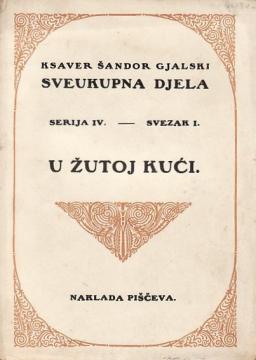
This edition belongs to the series Collected Works by Ksaver Šandor Gjalski (Series IV, Volume I), Piščeva naklada, 1914. In a bibliographical sense, this is an early, author-curated edition that shaped the canonical reception. For the reader, this means a classic style, editorial stability, and the historical “timbre” of the era.
One copy is available
- Restored spine