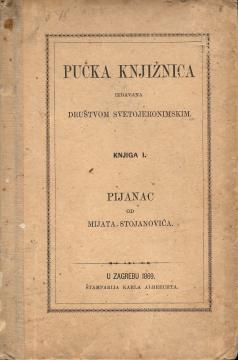
Pijanac
Antique
Rare book

Pijanac

Mijat Stojanović

"The Drunkard" by Mijat Stojanović (1869) is a folk tale adapted from I. A. Stelzig. A moralistic story about the harmful effects of alcoholism, intended for the general public. A classic example of 19th-century enlightenment literature.

"The Drunkard" is a folk book published in 1869 in Zagreb by the Society of St. Jerome (Croatian Catholic Society for the Propagation of Folk Books). The author Mijat Stojanović (1818–1881), a famous Slavonian pedagogue, ethnographer and folk writer from Babine Greda, adapted it from the German original by I. A. Stelzig for Croatian readers.

The work is a classic moral-didactic tale of the 19th century that vividly and in simple folk language depicts the ruin of a man and an entire family due to drunkenness. The fate of the main character highlights the social, health and moral consequences of alcoholism, with a clear lesson about sobriety, work and Christian virtues. The style is conversational, close to folk lore and everyday life in Slavonia, which enabled Stojanović to reach broad peasant strata.

The book belongs to a series of educational publications of the Society of St. Jerome, which in the second half of the 19th century sought to raise the morale and literacy of the Croatian people and to fight against the widespread social vice – alcoholism.

The Drunkard has significant antiquarian and bibliographic value. It is a rare folk book from the early period of Croatian folk literature, when such publications were crucial for the spread of literacy and national consciousness among the peasantry. Most copies from that time have not been preserved in large numbers because the books were read until they were read in villages and public libraries.

Copies in excellent condition are extremely rare on the antiquarian market and represent a sought-after rarity for collectors of 19th-century Croatian books, especially those related to the Illyrian Revival, the work of the Society of St. Jerome and public education. It has high documentary and bibliographic value for museums and private collections.

Dimensions
19 x 13.5 cm
Pages
161
Publisher
Hrvatsko književno društvo Sv. Jeronima, Zagreb, 1869.
 
Latin alphabet. Hardcover.
Language: Croatian.

One copy is available

Condition:Used, excellent condition
 

Are you interested in another book? You can search the offer using our search engine or browse books by category.

You may also be interested in these titles

Priče o braku i seksu

Priče o braku i seksu

Michal Viewegh

The book contains about twenty stories connected into one whole by the main character (the writer Oskar). It is, therefore, a kind of novel that, through intimate confessions, actually talks about the loneliness of the modern intellectual.

DiVič, 1999.
Croatian. Latin alphabet. Hardcover.
7.40 - 7.46
Inšallah Madona, inšallah

Inšallah Madona, inšallah

Miljenko Jergović

Inšalh, Madonna, Inšalah by Miljenko Jergović is a collection of stories whose richness of motifs and emotions branches out like carved ivory – in each story a story, in each destiny an entire world.

Durieux, 2004.
Croatian. Latin alphabet. Paperback.
16.3211.42
Spisateljica koja je poklanjala knjige

Spisateljica koja je poklanjala knjige

Terezija Dinter
Novi redak, 2020.
Croatian. Latin alphabet. Paperback.
8.98
Prvo šišanje

Prvo šišanje

Bohumil Hrabal

The First Haircut, a short story written in 1970 and published in 1976, is the first in a series of prose pieces by Bohumil Hrabal describing Nymburk, the town where he spent his childhood. In 1981, The First Haircut was adapted for the screen by Jiry Men

24 sata, 2007.
Croatian. Latin alphabet. Paperback.
7.245.43
Najbolje ljubavne priče

Najbolje ljubavne priče

An anthology of short love stories from world literature, selected for a wide audience in socialist Yugoslavia. Hadžić's selection highlights quality and diversity, making it a valuable example of Yugoslav popular literature.

Novinarsko izdavačko poduzeće, 1961.
Croatian. Latin alphabet. Paperback.
4.36 - 4.64
Svetlosti Rima

Svetlosti Rima

Alberto Moravia

Through these stories, Moravia explores themes of social inequality, the struggle for survival, and human frailty, portraying them with a mix of humor, irony, and realistic observation.

Svjetlost, 1965.
Serbian. Latin alphabet. Paperback.
3.82 - 3.92