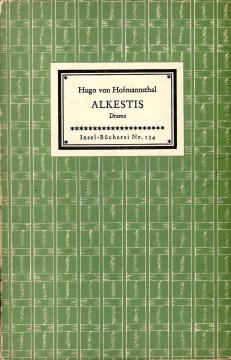
Aklestis: Drama

Aklestis: Drama

Hugo von Hofmannsthal

"Alcestis" is a modern reworking of the ancient myth about Queen Alcestis who willingly sacrifices her own life to save her husband Admetus. A drama about love, sacrifice and human moral responsibility.

The play Alcestis by the Austrian writer Hugo von Hofmannsthal is based on a well-known ancient myth that was adapted by Euripides in ancient Greece. Hofmannsthal retains the basic plot, but gives it a modern psychological and symbolic meaning, characteristic of the literature of the transition from the 19th to the 20th century.

The main character is King Admetus, who is destined to die. The gods offer him the opportunity to stay alive if someone else voluntarily dies in his place. While his parents refuse the sacrifice, his wife Alcestis accepts her own death in order to save her husband. Her decision becomes the center of the dramatic conflict and raises questions about the limits of love, loyalty and human responsibility. After Alcestis's death, Admetus is left facing guilt and the realization of the price he paid for his own life.

Hofmannsthal does not portray Alcestis only as an exemplary wife, but as a strong and morally exalted person whose sacrifice transcends personal interests. At the same time, the character of Admetus shows human weakness, fear of death and inner insecurity. The drama thus becomes more than a mythological story – it is a philosophical reflection on the meaning of life and the value of self-sacrifice.

Dimensions
18 x 11.5 cm
Pages
53
Publisher
Insel-Verlag, Wiesbaden, 1951.
 
Latin alphabet. Paperback.
Language: German.

One copy is available

Condition:Used, excellent condition
 

Are you interested in another book? You can search the offer using our search engine or browse books by category.

You may also be interested in these titles

U Bečkom Novom Mjestu: Epilog zrinsko-frankopanskoj tragediji u jednom činu

U Bečkom Novom Mjestu: Epilog zrinsko-frankopanskoj tragediji u jednom činu

Milan Ogrizović

In Vienna's New Town (1921) is a one-act play – an epilogue to the Zrinski-Frankopan Tragedy. It commemorates the 250th anniversary of the execution of Zrinski and Frankopan in Vienna's New Town in 1671.

Matica hrvatska, 1921.
Croatian. Latin alphabet. Paperback.
6.58
Zaplakala stara majka Džaferbegova: Drama u 3 čina

Zaplakala stara majka Džaferbegova: Drama u 3 čina

Jakša Kušan

A three-act drama by Jakša Kušan based on the motifs of the famous Bosnian sevdalinka of the same title, it is one of Kušan's early dramatic works inspired by the Muslim environment of Bosnia.

Tiskara braća Jakšić, 1942.
Croatian. Latin alphabet. Paperback.
9.74
Judita

Judita

Marko Marulić

Judith by Marko Marulić is an epic poem about a brave widow who, through her beauty, faith, and wisdom, saves her people by seducing and killing the Assyrian military leader Holofernes.

Zagrebačka stvarnost, 1995.
Croatian. Latin alphabet. Hardcover.
9.36
Slike Marijine

Slike Marijine

Lydia Scheuermann-Hodak
Vlastita naklada, 1999.
Croatian. Latin alphabet. Paperback.
4.98
Tirena

Tirena

Marin Držić

Pastoral drama (comedy) in five acts, written in double-rhymed twelve-line stanzas (with eight-line stanzas in the lyrical parts), the oldest preserved play by Držić (premiered in 1548 in Dubrovnik, printed in 1551 in Venice).

Matica hrvatska, 1948.
Croatian. Latin alphabet. Hardcover.
7.36
Razotkrivanja: tri različite drame

Razotkrivanja: tri različite drame

Miro Gavran

The book is a collection of three plays by one of the most performed contemporary playwrights, whose works have been translated into over 40 languages ​​and performed in more than 450 premieres around the world.

Quorum, 1989.
Croatian. Latin alphabet. Paperback.
7.32