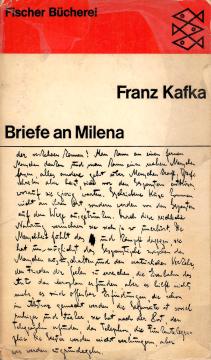
Briefe an Milena

Briefe an Milena

Franz Kafka

Briefe an Milena brings together Kafka's letters to Milena Jesenska, born of an intense spiritual and emotional closeness. The book reveals a love imbued with longing, fear, illness, and the impossibility of living together.

Kafka's Briefe an Milena is one of the most intimate and moving testimonies about his private life. They are letters addressed to Milena Jesenská, a Czech journalist, writer and translator who was among the first to translate Kafka into Czech. Their relationship began in 1920, when Milena contacted him about translating his texts, and it quickly developed into a strong, complex and deeply ambivalent relationship.

These letters are not only a love correspondence but also a record of the meeting of two extremely sensitive and intellectually strong people. Kafka shows himself more vulnerable in them than anywhere else: he is gentle, obsessively introspective, full of desire for closeness, but also paralyzed by the fear of a real relationship. Milena was extremely important to him because he experienced her as a person who truly understands him - a rarity in his life. However, the relationship was burdened by distance, her marriage, his illness, anxiety, and a deep sense of her own non-belonging.

The interesting thing about this book is that Milena was not only the recipient of Kafka's love, but also a key mediator of Kafka's work. Their correspondence reveals how literature, eros, fear, and loneliness were inseparable in Kafka. This is why this book is valuable both as a biographical document and as an extraordinary read about a love that was real, powerful, and almost impossible in advance.

Dimensions
18 x 10.5 cm
Pages
220
Publisher
Fischer Bücherei / Fischer Taschenbuch Verlag, Frankfurt am Main, 1966.
 
Latin alphabet. Paperback.
Language: German.

One copy is available

Condition:Used, very good condition
 

Are you interested in another book? You can search the offer using our search engine or browse books by category.

You may also be interested in these titles

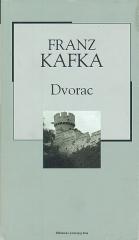
Dvorac

Dvorac

Franz Kafka

The Castle is Franz Kafka's last novel. In it, the protagonist known only as "K." he arrives in the village and struggles to gain access to the mysterious authorities who rule it from a castle supposedly owned by Count Westwest.

Jutarnji list, 2004.
Croatian. Latin alphabet. Hardcover with dust jacket.
4.99 - 5.22
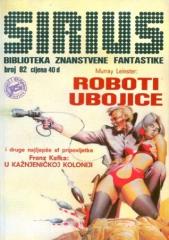
Sirius #82: Biblioteka znanstvene fantastike

Sirius #82: Biblioteka znanstvene fantastike

Murray Leinster, Damir Bajs, Miroslav Bošnjaković, Rastislav Durman, Krunoslav Gernhard, Jakob Z....

Sirius war ein kroatisches Science-Fiction-Magazin. Die Gründung wurde 1976 von Damir Mikuličić vorgeschlagen. In Sirius wurden Werke inländischer Autoren sowie Übersetzungen ausländischer Science-Fiction-Autoren veröffentlicht. Es wurde von 1976 bis 1989

Vjesnik, 1983.
Croatian. Latin alphabet. Paperback.
2.00
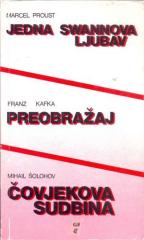
Jedna Swannova ljubav / Preobražaj / Čovjekova sudbina

Jedna Swannova ljubav / Preobražaj / Čovjekova sudbina

Marcel Proust, Franz Kafka, Mihail Šolohov

Ovako ponuđen izbor naslova odabrane srednjoškolske lektire tročlan je i po svojoj tematskoj usmjerenosti, koja je u Prousta viđena u starom svijetu, kod Šolohova u novom životu, kod Kafke u nepouzdanom čovjekovom znaku.

Stvarnost, 1989.
Croatian. Latin alphabet. Paperback.
8.74
Kaiserove kulije: roman njemačke ratne mornarice

Kaiserove kulije: roman njemačke ratne mornarice

Theodor Plievier

Kaiserove kulije (1930.) antimilitaristički je roman Theodora Plieviera. Na temelju vlastitog iskustva prikazuje brutalan život običnih mornara u njemačkoj ratnoj mornarici za Prvi svjetski rat i matrosku pobunu 1917.

Naklada Binoza, 1934.
Croatian. Latin alphabet. Hardcover with dust jacket.
5.26
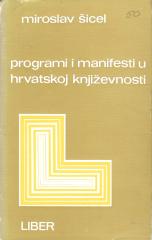
Programi i manifesti u hrvatskoj književnosti

Programi i manifesti u hrvatskoj književnosti

Miroslav Šicel

The collection "Programs and Manifestos in Croatian Literature", edited by Miroslav Šicel and published by Liber in 1972, represents a key collection of texts that shaped the direction of Croatian literature through various historical phases.

Liber, 1972.
Croatian. Latin alphabet. Paperback with dust jacket.
6.24
Dnevnik 1: Dnevnik 1914 - 17 (Davni dani I)

Dnevnik 1: Dnevnik 1914 - 17 (Davni dani I)

Miroslav Krleža

The 1914–17 diary records Krleža's writings from the First World War: personal dilemmas, pacifism, conflict with the militarism of the Monarchy, and intellectual maturation in the years of the collapse of the old world.

NIŠRO Oslobođenje, 1981.
Croatian. Latin alphabet. Hardcover.
6.784.75