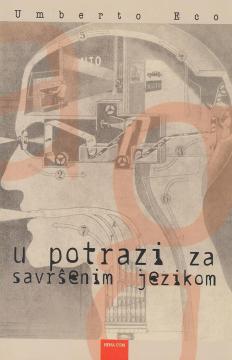
U potrazi za savršenim jezikom

Umberto Eco explores the centuries-long quest for a perfect, universal language that would transcend linguistic differences. He traces the philosophical, religious, and scientific attempts to create a language common to all humanity.
The Search for the Perfect Language (La ricerca della lingua perfetta nella cultura europea, 1993) is a scholarly work by the Italian writer, philosopher, and semiotician Umberto Eco, dedicated to the history of European efforts to find or create a perfect, universal language capable of overcoming the differences between nations and cultures.
Starting with the biblical story of the Tower of Babel and the lost unity of human speech, Eco explores how the idea of a primordial language has captivated theologians, philosophers, mystics, and scientists for centuries. He pays special attention to attempts to discover the language spoken by Adam and the first humans, as well as the belief that this language held the original truth about the world.
The author examines Hebrew as the presumed proto-language, medieval theories of language, the Kabbalistic tradition, the combinatorial method of Ramon Llull, and the linguistic reflections of Dante Alighieri. He also traces Renaissance and modern attempts to devise artificial languages that would enable the unambiguous expression of thought.
Significant space is devoted to the philosophical projects of Gottfried Wilhelm Leibniz, systems of universal signs and knowledge classification, and the development of international auxiliary languages, including Esperanto.
Eco demonstrates that the search for the perfect language is not merely a linguistic issue but also an expression of the human aspiration for complete knowledge, mutual understanding, and the ordering of the world. At the same time, he highlights the complexity of the relationship between language, thought, and reality. The book connects the history of ideas, the philosophy of language, semiotics, and cultural history, revealing how even unrealized linguistic projects contributed to the development of European science and the understanding of communication.
Two copies are available