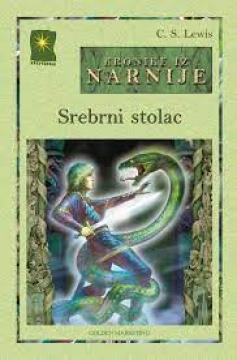
Kronike iz Narnije VI: Srebrni stolac
Prince Rilian, the beloved son of King Caspian, has mysteriously disappeared. Aslan sends Eustace and his school friend Jill to search for the prince in the ever-dark Underworld. The Wicked Witch is disturbing
In England, at an experimental school, Jill Pole and Eustace Scrubb are escaping from bullying and call out to Aslan. Aslan invites them to Narnia through a crack in the wall. There, Aslan sends them on a mission: to find the lost Prince Rilian, son of King Caspian X, who disappeared ten years earlier.
Aslan gives Jill four signs that she must memorize and repeat:
- Eustace will meet an old friend (King Caspian).
- They must travel north to the wild ruins of an old city.
- In that city, they will see an inscription on a stone and do what it says.
- They will recognize the prince by the fact that he will be the first to ask them for something in Aslan's name.
The children set off on a journey with Marshwiggle Puddleglum - a pessimistic but brave guide. They travel through swamps, encounter giants, and arrive at the ancient ruins of Harfang (where the giants wanted to eat them). On the stone they find the inscription: "UNDER THE EARTH LIES THE PRINCE'S HEIR".
They descend into the underworld through a crack and meet Prince Rilian - but he is under the spell of the Under-meadow Lady. She ties him to a silver chair every day so that he forgets who he is. When he is freed from the bonds, he goes mad and threatens Aslan, but Puddleglum, Jill and Eustace save him.
They discover that the Green Lady is actually the White Witch (Jadis) in a new form - she wants to conquer the surface world of Narnia. A battle breaks out in the underground city: Rilian kills the Green Lady, and her castle collapses. The three children and Rilian escape to the surface.
Caspian, now old and dying, comes to say goodbye. Aslan restores him to his youth and takes him to his country. Jill and Eustace return to England changed - braver and better.
The story is an allegory of faith (remembering signs), temptation, false gods, and salvation through truth and courage. It is the last book in the chronological order of Narnia.
No copies available
The last copy was sold recently.