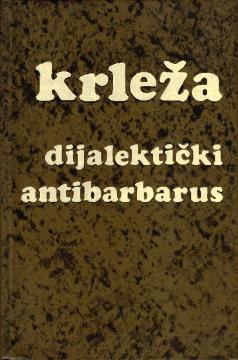
Dijalektički antibarbarus

Dijalektički antibarbarus

Miroslav Krleža

Krleža's most famous polemical text, in which he sharply attacks dogmatic vulgar Marxism and bad tendentious literature within the left, defending artistic freedom and intellectual autonomy. The culmination of the conflict on the literary left.

1,287 Dialectic Antibarbarian is one of the most powerful polemical works by Miroslav Krleža, published in 1939 in the magazine Pečat. It was later included in the collected works.

The title ironically alludes to the old linguistic “antibarbarians”. Krleža transforms it into a critique of “barbarism” within left-wing literature – the dogmatic, simplified and servile application of Marxism to art. The main target of the polemic were party critics (especially Radovan Zogović and the like) who demanded vulgar social tendentiousness and accused Krleža of bourgeois aestheticism.

Krleža brilliantly defends the right to artistic diversity, stylistic luxury and creative freedom. The text is full of irony, sarcasm and intellectual superiority, but also deep bitterness due to the conflict within his own camp.

The work represents the culmination of the so-called “conflict on the left” on the eve of World War II. Although not dissident in the true sense, it clearly demonstrates Krleža's determination not to sacrifice artistic quality for the sake of an ideological line.

Dialectic Antibarbarus is considered a masterpiece of Croatian polemical prose – a rare example of lucid, passionate and stylistically virtuoso criticism of one's own side. It is indispensable for understanding Krleža's worldview, his struggle for the autonomy of art, and the cultural conflicts in 20th-century Yugoslavia.

Editor
Miroslav Prstojević
Dimensions
20.5 x 13.5 cm
Pages
276
Publisher
NIŠRO Oslobođenje, Sarajevo, 1983.
 
Latin alphabet. Hardcover.
Language: Croatian.

One copy is available

Condition:Unused
 

Are you interested in another book? You can search the offer using our search engine or browse books by category.

You may also be interested in these titles

Na rubu pameti

Na rubu pameti

Miroslav Krleža

The novel "On the Edge of Reason" (1938) is Krleža's only novel in the first person. A doctor of law morally condemns a powerful industrialist at a banquet, thereby provoking a general social boycott, persecution, and his own downfall.

Jutarnji list, 2004.
Croatian. Latin alphabet. Hardcover with dust jacket.
5.26 - 5.62
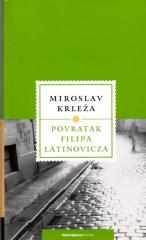
Povratak Filipa Latinovicza

Povratak Filipa Latinovicza

Miroslav Krleža

The Return of Filip Latinovicz is one of Miroslav Krleža's most famous novels. This novel is significant in our literature because it is considered the first fully modern Croatian novel.

Večernji list, 2004.
Croatian. Latin alphabet. Hardcover with dust jacket.
5.524.17 - 5.565.54
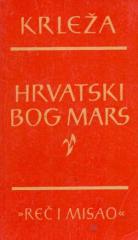
Hrvatski bog Mars

Hrvatski bog Mars

Miroslav Krleža

The Croatian god Mars brings seven anti-war novels in which Krleža portrays war as a cruel, senseless machinery that destroys the "little man", exposing the hypocrisy of militarism and myths about heroism.

Rad, 1965.
Serbian. Latin alphabet. Paperback.
1.99
Djela XIII: Theatralia: Scenski pokušaji, članci o kazalištu i koncertima, dio prvi (1897.–1909.)

Djela XIII: Theatralia: Scenski pokušaji, članci o kazalištu i koncertima, dio prvi (1897.–1909.)

Antun Gustav Matoš

The thirteenth volume of the first edition of Matoš's collected works brings together dramatic attempts and theater and concert criticism from the period 1897–1909, revealing Matoš as an insightful theater critic.

Naklada Binoza, 1939.
Croatian. Latin alphabet. Hardcover.
8.42
Djala 9: Pečalba - Kaprisi i feljtoni

Djala 9: Pečalba - Kaprisi i feljtoni

Antun Gustav Matoš

Book of Works 9: Pečalba – Caprices and Feuilletons is a collection of caprices, feuilletons and satirical writings with sharp criticism of society, irony, humor and Matoš's bohemian, polemical spirit.

Naklada Binoza, 1939.
Croatian. Latin alphabet. Hardcover.
8.72
Djela X: Dragi naši savremenici: Polemike, epigrami i satire

Djela X: Dragi naši savremenici: Polemike, epigrami i satire

Antun Gustav Matoš

The tenth volume of Matoš's works brings together polemics, epigrams, and satires in which the author sharply comments on his contemporaries, society, literature, and politics, confirming his sharp critical style.

Naklada Binoza, 1939.
Croatian. Latin alphabet. Hardcover.
8.26