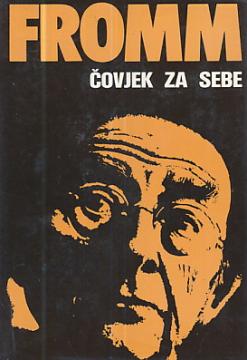
Čovjek za sebe - Istraživanje o psihologiji etike

Čovjek za sebe - Istraživanje o psihologiji etike

Erich Fromm

In the book "Man for Himself", Erich Fromm develops the idea of ​​humanistic ethics as opposed to authoritarian and relativist ethics.

Approaching the problem through a combination of psychoanalysis, philosophy and sociology, Fromm argues that morality should not be based on external authorities (God, society, tradition), but on the inner nature of man. Ethics does not arise from orders, but from man's aspiration to become a fully developed, authentic human being.

According to Fromm, man is neither good nor evil by nature, but a potential that develops depending on social conditions. In a healthy society, ethical behavior arises from love, reason and a productive orientation - the ability to love, create and act in harmony with oneself and others. In contrast, in repressive or alienated societies, people often develop destructive and unethical patterns of behavior.

Fromm particularly criticizes the authoritarian conscience - a sense of guilt based on the fear of punishment - and advocates the development of a humanistic conscience, which arises from the awareness of one's own growth and acting in accordance with inner truth. Ethics, according to him, is a necessary part of spiritual and emotional health.

In conclusion, "Man for Himself" calls for the creation of a society that supports individual freedom, love, and responsibility as the foundations of true ethics.

Original title
Man for himself
Translation
Hrvoje Lisinski
Editor
Željko Falout, Gvozden Flego
Graphics design
Ratko Janjić-Jobo
Dimensions
20.5 x 15 cm
Pages
228
Publisher
Naprijed, Zagreb, 1989.
 
Distribution: 3,000 copies
 
Latin alphabet. Hardcover with dust jacket.
Language: Croatian.
ISBN
8-63-490206-4

No copies available

The last copy was sold recently.

 

Are you interested in another book? You can search the offer using our search engine or browse books by category.

You may also be interested in these titles

Kriza psihoanalize - Analitička socijalna psihologija i društvena teorija

Kriza psihoanalize - Analitička socijalna psihologija i društvena teorija

Erich Fromm

In the book, Fromm presents a strong critique of contemporary psychoanalysis. He believes that psychoanalysis has moved away from Freud's initial revolutionary vision and has turned into a technical, often sterile system that ignores deeper human and soci

Naprijed, 1989.
Croatian. Latin alphabet. Hardcover with dust jacket.
6.345.24 - 6.986.34
Veličina i granice Freudove misli

Veličina i granice Freudove misli

Erich Fromm
Naprijed, 1989.
Croatian. Latin alphabet. Hardcover with dust jacket.
6.34 - 6.98
Zdravo društvo

Zdravo društvo

Erich Fromm

In his book "The Healthy Society," Erich Fromm explores what makes a society psychologically healthy and what makes it unhealthy. The book represents the crowning achievement of Fromm's social and political philosophy, in which he favors a so-called human

Naprijed, 1989.
Croatian. Latin alphabet. Hardcover with dust jacket.
6.34
Nauka o čovjeku: Za gimnazije

Nauka o čovjeku: Za gimnazije

Franjo Dolenec, Ante Lui

"The Science of Man" is a textbook by Franjo Dolenec and Ante Lui, intended for high school students. The book provides a fundamental understanding of human anatomy and physiology, adapted for high school education.

Školska knjiga, 1967.
Croatian. Latin alphabet. Paperback.
6.84
Ljudska devolucija: Vedska alternativa Darwinovoj teoriji evolucije

Ljudska devolucija: Vedska alternativa Darwinovoj teoriji evolucije

Michael A. Cremo

The book Human Devolution represents one of the boldest and most comprehensive attempts for modern science to confront its own limits and openly acknowledge the existence of evidence that does not fit into the official story of human origins.

Stari grad, 2007.
Croatian. Latin alphabet. Hardcover.
32.54
Kultura neandertalaca: Čuvari drevne mudrosti

Kultura neandertalaca: Čuvari drevne mudrosti

In this strongly documented book, the British psychologist and researcher claims that Neanderthals were the bearers of an older, more powerful, and spiritually richer culture than Cro-Magnon ("modern" man), and that it was their tradition that formed the

Stari grad, 2006.
Croatian. Latin alphabet. Hardcover.
14.22 - 14.28