Erich Fromm

Erich Fromm (Frankfurt am Main, March 23, 1900 – Muralto, Switzerland, March 18, 1980) was a German-American psychoanalyst, social psychologist, and philosopher, as well as one of the most important figures in humanistic psychoanalysis. His work integrates psychology, philosophy, sociology, and ethics, focusing centrally on human freedom, love, alienation, and the individual's relationship with society.
He grew up in a Jewish family, studied sociology in Heidelberg—where he earned his doctorate in 1922—and subsequently trained in psychoanalysis. He was associated with the Frankfurt School and the Institute for Social Research, contributing to the latter's development by linking Freudian psychoanalysis with Marxian social critique. Following the Nazi rise to power, he emigrated to the United States and later worked in Mexico as well.
He gained international recognition with the book Escape from Freedom (1941), in which he explores why modern man, faced with insecurity and responsibility, might relinquish freedom in favor of authoritarian systems. In Man for Himself, he lays the foundations of humanistic ethics, while in The Sane Society, he analyzes the psychological consequences of capitalism, conformity, and alienation. His most famous work, The Art of Loving (1956), portrays love as an active capacity requiring knowledge, discipline, responsibility, and care, rather than merely a feeling. In the book To Have or to Be? (1976), he contrasts two fundamental modes of human existence: having and authentic living.
Other significant works include Psychoanalysis and Religion, The Forgotten Language, Marx's Concept of Man, The Anatomy of Human Destructiveness, The Art of Loving, and The Revolution of Hope.
Fromm criticized consumer society, authoritarianism, nationalism, and dehumanization, advocating for a society founded on solidarity, creativity, and human dignity. His accessible yet philosophically grounded works have left a lasting impact on psychology, social theory, and contemporary reflections on love, freedom, and the meaning of human life.
Titles in our offer
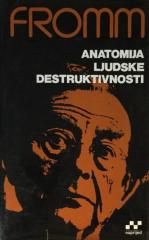
Anatomija ljudske destruktivnosti
In a world that is constantly seeing an increase in violence in its various forms, Erich Fromm treats this problem in an extremely insightful way in one of his most significant books.
Anatomija ljudske destruktivnosti
In a world that is constantly seeing an increase in violence in its various forms, Erich Fromm treats this problem in an extremely insightful way in one of his most significant books.
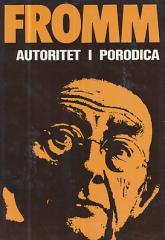
Autoritet i porodica
In his work "Authority and Family", Erich Fromm analyzes the transformation of authority and family in modern society. The foreword was written by Gvozden Flego, and the book also contains the study "Revolutionary Character".
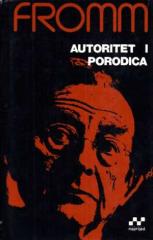
Autoritet i porodica
In his work "Authority and Family", Erich Fromm analyzes the transformation of authority and family in modern society. The foreword was written by Gvozden Flego, and the book also contains the study "Revolutionary Character".
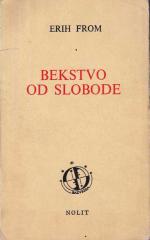
Bekstvo od slobode
Erich Fromm's iconic psychoanalytic study explores why modern man, having freed himself from traditional constraints, often returns to totalitarian ideologies in search of security.
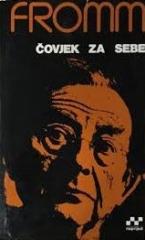
Čovjek za sebe: Istraživanje o psihologiji etike
Fromm explores psychoanalytic ethics, arguing that moral laws are based on human nature. He contrasts authoritarian and humanistic ethics, emphasizing the importance of freedom and productive character for the development of a healthy individual.
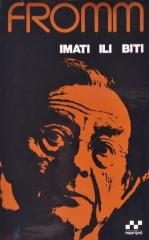
Imati ili biti
The book is one of the capital works of the second half of the twentieth century. According to Fromm, it continues two tendencies of his previous works - the analysis of selfishness and altruism as two fundamental character orientations.
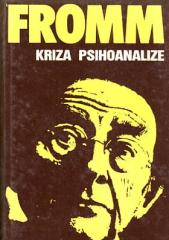
Kriza psihoanalize - Analitička socijalna psihologija i društvena teorija
In the book, Fromm presents a strong critique of contemporary psychoanalysis. He believes that psychoanalysis has moved away from Freud's initial revolutionary vision and has turned into a technical, often sterile system that ignores deeper human and soci
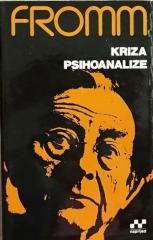
Kriza psihoanalize: Analitička socijalna psihologija i društvena teorija
Fromm analyzes the crisis of Freudianism, advocating for a synthesis of psychoanalysis and Marxism. He illustrates how social structures shape human character and emphasizes the importance of revolutionary humanism.

Marksovo shvatanje čoveka
A philosophical and sociological study of Erich Fromm. The author reinterprets the thought of Karl Marx, emphasizing his neglected humanism, critique of alienation, and vision of liberation and full human development.