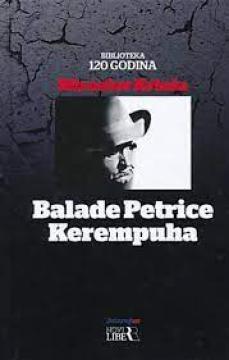
Balade Petrice Kerempuha

Balade Petrice Kerempuha

Miroslav Krleža

Miroslav Krleža's greatest poetic achievement and one of the most important works of Croatian literature. The ballads combine satire, irony, and lyrical-folkloric tones in a condemnation of violence and stupidity of government throughout the centuries.

In Ballads of Petrica Kerempuh, Miroslav Krleža creates a literary work that simultaneously acts as a historical lament, a political indictment, and a poetic fresco of the Croatian north. The main voice of the collection, the fictional Petrica Kerempuh, a folk sage and mocker, observes history “from below”: from the perspective of peasants, serfs, marginalized people, and all those over whom foreign rule has been imposed for centuries.

The collection covers a wide time span — from medieval rebellions and persecutions to the tragedies of the early modern era. Through kajkavština, a language full of rhythm, metaphors, proverbs, and ironic puns, Krleža brings to life the entire world of lost voices: victims of violence, hungry, ridiculed, deceived. Petrica moves through this landscape as a commentator, not submissive, but not naive either — his humor carries the bitterness of experience, and his irony exposes the cruelty of those in power.

In the background of the ballads, the horrors of history unfold: hangings, military campaigns, rebellions, epidemics, robberies and political persecutions. But in this darkness, Krleža also finds motives of resistance — the defiance of the peasant masses, the strength of unity, laughter as the last weapon of those who have no other. The collection thus becomes a chronicle of suffering, but also a testimony to the perseverance of a people who survive thanks to wit and unwavering hope.

Petrica, as a lyrical protagonist, embodies the combination of folk wisdom and literary mask. He sees everything: the emptiness of historical ideologies, the hypocrisy of the authorities, the repetition of tragedies. Krleža uses him to speak about centuries-old injustice, but also to show how the truth is often preserved in the language of mockers and jokes, and not in the speeches of rulers.

Editor
Slavko Goldstein, Krešimir Nemec
Dimensions
20 x 13 cm
Pages
178
Publisher
Novi Liber, Zagreb, 2013.
 
Latin alphabet. Hardcover.
Language: Croatian.

Two copies are available

Copy number 1

Condition:Unused

Copy number 2

Condition:Used, excellent condition
 

Are you interested in another book? You can search the offer using our search engine or browse books by category.

You may also be interested in these titles

Izabrane pjesme

Izabrane pjesme

Miroslav Krleža
Matica hrvatska, 1963.
Croatian. Latin alphabet. Hardcover with dust jacket.
9.99
Povratak Filipa Latinovicza

Povratak Filipa Latinovicza

Miroslav Krleža

Povratak Filipa Latinovića jedan je od najpoznatijih romana Miroslava Krleže. Ovaj roman je značajan u našoj književnosti jer se smatra prvim potpuno modernim hrvatskim romanom.

Večernji list, 2004.
Croatian. Latin alphabet. Hardcover with dust jacket.
5.52 - 5.56
Hrvatski bog Mars

Hrvatski bog Mars

Miroslav Krleža

Hrvatski bog Mars donosi sedam antiratnih romana u kojima Krleža prikazuje rat kao surovu, besmislenu mašineriju koja uništava „malog čoveka“, razotkrivajući licemerje militarizma i mitove o herojstvu.

Rad, 1965.
Serbian. Latin alphabet. Paperback.
1.99
Sve ča mi rabi ovega prolića

Sve ča mi rabi ovega prolića

Evelin Rudan

Sve ča mi rabi ovega prolića prva je samostalna pesnička zbirka Evelin Rudan, pulsko-zagrebačke pesnikinje i naučnice (rođ. 1971.). Knjiga predstavlja markantan doprinos savremenoj istarskoj čakavskoj lirici.

Naklada MD, 2000.
Croatian. Latin alphabet. Paperback.
5.32
Malo prije svega odavno smo

Malo prije svega odavno smo

Goran Rem

„Malo pre svega, davno smo mi“ je jedanaesta zbirka poezije Gorana Rema (rođ. 1958, Osijek), pesnika, esejiste, književnog istoričara i pripadnika generacije Quorum u hrvatskoj književnosti.

MeandarMedia, 2024.
Croatian. Latin alphabet. Paperback with dust jacket.
12.34
Tigris / Tigar

Tigris / Tigar

Tomislav Marijan Bilosnić

Dvojezično mađarsko-hrvatsko izdanje zbirke pesama „Tigar“ predstavlja izbor iz opsežnog ciklusa od oko 150–200 pesama o tigru - simbolu snage, slobode, divljine, kosmosa, podsvesti i povratka iskonskom.

Magyar Napló, 2023.
Hungarian. Latin alphabet. Paperback.
5.384.04