Sibirski pečat

Sibirski pečat

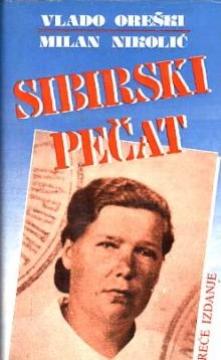
Vlado Oreški, Milan Nikolić

Memoirs of Agata Oreški (1906-1991), a Croatian revolutionary and the only woman from Yugoslavia to survive Stalin's concentration camps. The book was compiled by her son Vlado Oreški and Milan Nikolić, with a foreword by Slavko Goldstein.

The book provides testimony about the eight-year ordeal in the Soviet gulags from 1937 to 1945, during the Great Purge. In 1935, the Central Committee of the Communist Party of Yugoslavia, at the suggestion of Josip Broz Tito, sent Agata – the widow of the murdered SKOJ secretary Mijo Oreški – with her 8-year-old son Vladimir to the USSR, to escape persecution and poverty in the Kingdom of Yugoslavia. Instead of safety, Agata fell into Stalin's terror: the NKVD took her child away from her (who was sent to an orphanage), arrested her in 1937 on charges of being a "Yugoslav spy". After torture, endless interrogations and torture (physical and psychological), she was sentenced to 8 years without admitting guilt.

The path of Calvary leads through the prison in Bryansk (where she suffers from hunger, disease and abuse), the Arkhangelsk concentration camp (cold, forced labour), the Papinka death camp (high mortality, starvation, epidemics) and Talaga (Siberian mines, exhausting work at -50°C, loss of comrades). Agata describes daily life in hell: crumbs of food, diseases (typhoid, dysentery), suicides, but also the solidarity of the prisoners – mostly women from various countries, including Yugoslavs and internationalists. She survives through willpower, faith in communism (which betrayed her) and maternal care for her son, whom she meets again in 1945 in Zagreb, thanks to Tito's diplomatic interventions.

The book exposes the paradox of communist idealism: a humanitarian "way out" turns into a nightmare of betrayal. Agata, an unyielding idealist, bears witness to the dehumanisation in the gulag – a symbol of totalitarianism – but also to human resilience, friendship and hope. The pessimistic tone is reminiscent of Solzhenitsyn, but with an intimate, feminine perspective: maternal love against the machinery of evil.

Goldstein's foreword contextualizes the events within Stalin's purges, where Yugoslav communists (accused of Trotskyism) also suffered. This testimony is not just a personal story, but a warning about the dangers of fanaticism and totalitarianism. Agata's courage leaves a "Siberian stamp" - a scar of survival that shapes history.

Dimenzije
21 x 13 cm
Broj strana
258
Nakladnik
Sveučilišna naklada Liber (SNL), Zagreb, 1983.
 
Latinica. Tvrde korice s ovitkom.
Jezik: Hrvatski.

Više primjeraka je u ponudi

Primjerak broj 1

Stanje:Korišteno, u odličnom stanju
Dodano u košaricu!

Primjerak broj 2

Stanje:Korišteno, u odličnom stanju
Dodano u košaricu!

Primjerak broj 3

Stanje:Korišteno, u odličnom stanju
Dodano u košaricu!

Primjerak broj 4

Stanje:Korišteno, u odličnom stanju
Dodano u košaricu!
 

Zanima Vas i neka druga knjiga? Možete pretražiti našu ponudu pomoću tražilice ili prelistati knjige po kategorijama.

Možda će Vas zanimati i ovi naslovi

Teror narodu: Povijest OZNE, Titove političke policije

Teror narodu: Povijest OZNE, Titove političke policije

William Klinger

In the book, historian William Klinger investigates the origin and operation of OZNA - the brutal repressive apparatus of communist Yugoslavia, which monitored, imprisoned and liquidated political opponents.

Večernji list, 2014.
Hrvatski. Latinica. Broširano.
7,34
Povratak iz Gulaga: Tajni referat Hruščova

Povratak iz Gulaga: Tajni referat Hruščova

Karlo Štajner

A sequel to his memoir 7000 Days in Siberia, in which he describes his twenty-year imprisonment in Soviet gulags. The book delves into his experiences in the camps, providing additional insights into Steiner's life and reflections on communist ideals.

Globus, 1986.
Hrvatski. Latinica. Tvrde korice s ovitkom.
10,767,53 - 11,248,43
Doživljaji i putovanja do slobode

Doživljaji i putovanja do slobode

Vladimir Novak

The autobiographical work of Croatian communist activist Vladimir Novak, a survivor of the Ustasha camps, follows his memories of resistance to fascism during World War II.

August Cesarec, 1979.
Hrvatski. Latinica. Tvrde korice s ovitkom.
8,26
Živojin Pavlović: Između dogme i kritike

Živojin Pavlović: Između dogme i kritike

Slobodan Gavrilović

In terms of the number and content of facts, systematics, and method of interpretation, Gavrilović's work surpasses ordinary historiographical reading and stands side by side with the best literary creations about the events of one time and their actors.

Grafocard, 2001.
Srpski. Ćirilica. Broširano.
9,58
O nacionalnoj istoriji kao vaspitnom predmetu

O nacionalnoj istoriji kao vaspitnom predmetu

Milovan Đilas

A programmatic text in which Đilas, as a senior party ideologist, sets out Marxist-Leninist guidelines for the teaching and writing of national (Yugoslav) history as a means of education and ideological struggle.

Pedagoško-književni zbor, 1949.
Srpski. Latinica. Broširano.
14,36
Snažan eho brionski: Odjeci Brionskog plenuma u Bosni i Hercegovini 1966. godine

Snažan eho brionski: Odjeci Brionskog plenuma u Bosni i Hercegovini 1966. godine

Amir Duranović

Amir Duranović's book reconstructs in detail the dramatic year 1966 and the Fourth (Brion) Session of the Central Committee of the Communist Party of Yugoslavia (July 1–2, 1966), at which Aleksandar Ranković, the long-time head of the UDB and vice preside

Udruženje za modernu historiju (UMHIS), 2017.
Hrvatski. Latinica. Broširano.
9,547,63