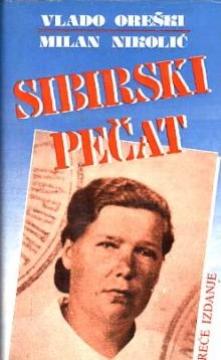
Sibirski pečat

Sibirski pečat

Vlado Oreški, Milan Nikolić

Memoirs of Agata Oreški (1906-1991), a Croatian revolutionary and the only woman from Yugoslavia to survive Stalin's concentration camps. The book was compiled by her son Vlado Oreški and Milan Nikolić, with a foreword by Slavko Goldstein.

The book provides testimony about the eight-year ordeal in the Soviet gulags from 1937 to 1945, during the Great Purge. In 1935, the Central Committee of the Communist Party of Yugoslavia, at the suggestion of Josip Broz Tito, sent Agata – the widow of the murdered SKOJ secretary Mijo Oreški – with her 8-year-old son Vladimir to the USSR, to escape persecution and poverty in the Kingdom of Yugoslavia. Instead of safety, Agata fell into Stalin's terror: the NKVD took her child away from her (who was sent to an orphanage), arrested her in 1937 on charges of being a "Yugoslav spy". After torture, endless interrogations and torture (physical and psychological), she was sentenced to 8 years without admitting guilt.

The path of Calvary leads through the prison in Bryansk (where she suffers from hunger, disease and abuse), the Arkhangelsk concentration camp (cold, forced labour), the Papinka death camp (high mortality, starvation, epidemics) and Talaga (Siberian mines, exhausting work at -50°C, loss of comrades). Agata describes daily life in hell: crumbs of food, diseases (typhoid, dysentery), suicides, but also the solidarity of the prisoners – mostly women from various countries, including Yugoslavs and internationalists. She survives through willpower, faith in communism (which betrayed her) and maternal care for her son, whom she meets again in 1945 in Zagreb, thanks to Tito's diplomatic interventions.

The book exposes the paradox of communist idealism: a humanitarian "way out" turns into a nightmare of betrayal. Agata, an unyielding idealist, bears witness to the dehumanisation in the gulag – a symbol of totalitarianism – but also to human resilience, friendship and hope. The pessimistic tone is reminiscent of Solzhenitsyn, but with an intimate, feminine perspective: maternal love against the machinery of evil.

Goldstein's foreword contextualizes the events within Stalin's purges, where Yugoslav communists (accused of Trotskyism) also suffered. This testimony is not just a personal story, but a warning about the dangers of fanaticism and totalitarianism. Agata's courage leaves a "Siberian stamp" - a scar of survival that shapes history.

Dimensions
21 x 13 cm
Pages
258
Publisher
Sveučilišna naklada Liber (SNL), Zagreb, 1983.
 
Latin alphabet. Hardcover with dust jacket.
Language: Croatian.

Multiple copies are available

Copy number 1

Condition:Used, excellent condition

Copy number 2

Condition:Used, excellent condition

Copy number 3

Condition:Used, excellent condition

Copy number 4

Condition:Used, excellent condition
 

Are you interested in another book? You can search the offer using our search engine or browse books by category.

You may also be interested in these titles

Ruska kapitalistička revolucija

Ruska kapitalistička revolucija

Anders Åslund
Dnevnik d.o.o., 2010.
Croatian. Latin alphabet. Paperback.
23.9919.19
Svi Staljinovi ljudi

Svi Staljinovi ljudi

Roj Medvedev

Roj Medvedev's book is a collection of biographical portraits of six key collaborators of Joseph Stalin: Vyacheslav Molotov, Lazar Kaganovich, Anastasij Mikoyan, Kliment Voroshilov, Georgi Maljenkov and Mikhail Suslov.

Svjetlost, 1987.
Croatian. Latin alphabet. Hardcover.
11.34
Maček i politika hrvatske seljačke stranke 1928-1941

Maček i politika hrvatske seljačke stranke 1928-1941

Ljubo Boban

Boban's book contains a solid, comprehensive and reliable treatment of the main points of the political path of Maček and the HSS in the era of Croatian and Yugoslav politics from 1928 to 1941.

Sveučilišna naklada Liber (SNL), 1974.
Croatian. Latin alphabet. Hardcover with dust jacket.
The book consists of two volumes
12.56 - 15.38
Sudbonosni podvig Jugoslavije: Podsjećanje na historijsko NE staljinizmu, događaj koji je opredijelio budućnost Jugoslavije

Sudbonosni podvig Jugoslavije: Podsjećanje na historijsko NE staljinizmu, događaj koji je opredijelio budućnost Jugoslavije

Raif Dizdarević

The book by Raif Dizdarević, one of the last living actors of Yugoslav diplomacy, presents his reconstruction of the most fateful moment of post-war Yugoslavia – the split with Stalin and the Informburo in 1948–1953.

Udruženje za modernu historiju (UMHIS), 2018.
Croatian. Latin alphabet. Paperback.
23.58
Churchill i Eden u ratu

Churchill i Eden u ratu

Elisabeth Barker
Globus, 1980.
Croatian. Latin alphabet. Hardcover with dust jacket.
8.766.57
Jugoslavenske vlade u izbjeglištvu 1941-1943

Jugoslavenske vlade u izbjeglištvu 1941-1943

Bogdan Krizman, Branko Petranović

A two-volume work that documents the activities of Yugoslav governments in exile during World War II. The study represents a significant contribution to the study of the history of political processes during World War II.

Globus, 1981.
Croatian. Latin alphabet. Hardcover with dust jacket.
The book consists of two volumes
12.99