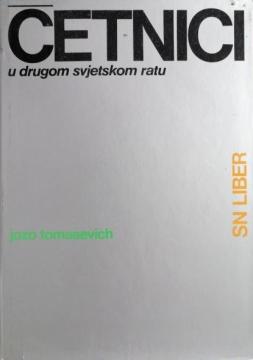
Četnici u Drugom svjetskom ratu 1941 - 1945

Četnici u Drugom svjetskom ratu 1941 - 1945

Jozo Tomasevich

This scholarly study by Croatian-American historian Jozo Tomašević provides a detailed analysis of the Chetnik movement during World War II.

Tomašević examines the political goals, military strategies, and relations of the Chetniks with the occupying forces, the Partisans, and the Yugoslav government in exile. The Chetnik movement, led by General Draž Mihailović, was initially presented as a resistance to the occupiers, but the author emphasizes that its main goal was the establishment of an ethnically homogeneous "Greater Serbia." This goal was often achieved through cooperation with Italian and German forces, especially in the fight against the Partisans. Tomašević documents numerous cases of collaboration, including agreements with the Italian authorities in eastern Bosnia, where the Chetniks received weapons and logistical support in exchange for refraining from attacking Italian troops.

The author also analyzes the ideological foundations of the Chetnik movement, especially the influence of Stevan Moljević's Memorandum on a "Homogeneous Serbia," which advocated the ethnic cleansing of non-Serb populations from territories earmarked for a future Serbian state. Tomašević describes in detail the crimes committed against the civilian population, especially against Muslims and Croats, which many historians consider genocide.

The book also examines the relationship between the Chetniks and the Yugoslav government in exile, and the changes in British policy towards the Chetniks, which culminated in the withdrawal of support for Mihailović in 1943. Tomašević's study is based on extensive documentation and represents a key source for understanding the complexity of the Chetnik movement and its role in war events in the former Yugoslavia.

"The events in Yugoslavia that followed the breakup of the multinational state in 1941... were so complex that no satisfactorily complete and objective history of that period has yet been written. The appearance of the book "The Chetniks"..., as the first part of the announced three-part study, gives us the promise that we finally have such a complete and complex history in sight... Professor Tomasevich deserves the highest praise for a thorough and objective scientific approach to a very complex subject, for which this book will to remain a basic manual for a long time..." (Stephen Clissold, »English Historical Review«, 1977)

Naslov izvornika
The Chetniks: War and Revolution in Yugoslavia 1941-1945
Prijevod
Nikica Petrak
Naslovnica
Mihajlo Arsovski
Dimenzije
24 x 17 cm
Broj strana
444
Nakladnik
Sveučilišna naklada Liber (SNL), Zagreb, 1979.
 
Latinica. Tvrde korice s ovitkom.
Jezik: Hrvatski.

Nema primjeraka u ponudi

Poslednji primjerak je nedavno prodan.
 

Zanima Vas i neka druga knjiga? Možete pretražiti našu ponudu pomoću tražilice ili prelistati knjige po kategorijama.

Možda će Vas zanimati i ovi naslovi

Hrvatska u arhivima izbjegličke vlade 1941-1943.: Izvještaji informatora o prilikama u Hrvatskoj

Hrvatska u arhivima izbjegličke vlade 1941-1943.: Izvještaji informatora o prilikama u Hrvatskoj

Ljubo Boban

Academician Ljubo Boban, in his work Croatia in the Archives of the Government in Exile 1941–1943, brings together a collection of diplomatic reports from various European and international representative offices of the Yugoslav government in exile during

Globus, 1985.
Hrvatski. Latinica. Tvrde korice s ovitkom.
9,52
Teror narodu: Povijest OZNE, Titove političke policije

Teror narodu: Povijest OZNE, Titove političke policije

William Klinger

In the book, historian William Klinger investigates the origin and operation of OZNA - the brutal repressive apparatus of communist Yugoslavia, which monitored, imprisoned and liquidated political opponents.

Večernji list, 2014.
Hrvatski. Latinica. Broširano.
7,34
Živojin Pavlović: Između dogme i kritike

Živojin Pavlović: Između dogme i kritike

Slobodan Gavrilović

In terms of the number and content of facts, systematics, and method of interpretation, Gavrilović's work surpasses ordinary historiographical reading and stands side by side with the best literary creations about the events of one time and their actors.

Grafocard, 2001.
Srpski. Ćirilica. Broširano.
9,58
Historija porodice Alibegović: transformacija iz begovske zemljoposjedničke u modernu građansku porodicu

Historija porodice Alibegović: transformacija iz begovske zemljoposjedničke u modernu građansku porodicu

Husnija Kamberović

The book depicts the development of a Bosnian bey family that, throughout the 19th and 20th centuries, transformed from a landowning family into a modern bourgeois family, reflecting broader social changes in Bosnia and Herzegovina.

Udruženje za modernu historiju (UMHIS), 2021.
Hrvatski. Latinica. Broširano.
18,52
Sudbonosni podvig Jugoslavije: Podsjećanje na historijsko NE staljinizmu, događaj koji je opredijelio budućnost Jugoslavije

Sudbonosni podvig Jugoslavije: Podsjećanje na historijsko NE staljinizmu, događaj koji je opredijelio budućnost Jugoslavije

Raif Dizdarević

The book by Raif Dizdarević, one of the last living actors of Yugoslav diplomacy, presents his reconstruction of the most fateful moment of post-war Yugoslavia – the split with Stalin and the Informburo in 1948–1953.

Udruženje za modernu historiju (UMHIS), 2018.
Hrvatski. Latinica. Broširano.
23,58
Knjiga o Srebrenici – spomenar jednog grada

Knjiga o Srebrenici – spomenar jednog grada

Sadik Salimović

Sadik Salimović's Book of Srebrenica (2002) is a memoir of the city: from Ottoman settlement, Islamization and development to the war suffering of 1992–1995 and genocide. It preserves the identity and memory of life before and after the tragedy.

Skupština opštine Srebrenica, 2002.
Hrvatski. Latinica. Broširano.
11,32