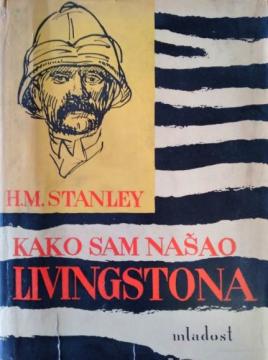
Kako sam našao Livingstona : Putovanja, doživljaji i otkrića u Centralnoj Africi
Rare book

Kako sam našao Livingstona : Putovanja, doživljaji i otkrića u Centralnoj Africi

Henry Morton Stanley

Henry Morton Stanley describes his 1871 expedition, organized by the New York Herald, to find the missing Scottish missionary and explorer David Livingstone in the heart of Africa. A classic of 19th-century travel and exploration literature.

The book details Stanley's expedition, which was launched in 1871 by the American newspaper New York Herald. The task was: to find David Livingstone, the famous Scottish missionary and explorer, who had not been heard from for years. Stanley, a journalist and adventurer, sets off from Zanzibar with a large caravan through the dangerous terrain of Central Africa - fighting diseases (malaria, dysentery), hunger, wild animals, hostile tribes and difficult terrain.

After eight months of wandering, on November 10, 1871, in the town of Ujiji on the shores of Lake Tanganyika, he meets the tormented, sick Livingstone. The legendary greeting Dr. Livingstone, And you presume? has become one of the most famous moments in the history of exploration.

Stanley describes in detail the geographical discoveries, encounters with natives, Arab slave traders, flora and fauna, but also the everyday difficulties of the expedition. The book is a mixture of adventure account, travelogue, and personal experience – written in a dynamic, dramatic, and sometimes sensationalist style that suited the tastes of the Victorian audience.

The work cemented Stanley’s status as a celebrated explorer and paved the way for his later major expeditions (e.g., down the Congo River). At the same time, it sheds light on the “dark continent” of Europe during the era of colonial aspirations.

Despite the controversy surrounding Stanley’s methods and later role in colonialism, the book remains a thrilling testament to courage, perseverance, and the spirit of exploration. It is recommended for anyone interested in African discovery, Victorian adventure, and classic travel writing.

Original title
How I Found Livingstone
Translation
Stojana Čulić
Graphics design
Dalibor Parać
Dimensions
20 x 15 cm
Pages
369
Publisher
Mladost, Zagreb, 1953.
 
Latin alphabet. Hardcover with dust jacket.
Language: Croatian.

One copy is available

Condition:Used, very good condition
Damages or inconvenience notice:
  • The cover is missing
 

Are you interested in another book? You can search the offer using our search engine or browse books by category.

You may also be interested in these titles

Put u Jajce

Put u Jajce

Edvard Kocbek

In Put u Jajce, Edvard Kocbek provides personal and political testimony about key moments in Yugoslav history. The book is based on Kocbek's memories from the Second World War, especially the trip to Jajce in 1943.

Znanje, 1978.
Croatian. Latin alphabet. Hardcover with dust jacket.
8.386.29
Posljednja nedjelja

Posljednja nedjelja

Milo Dor

The Last Sunday of Mila Dora is a historical novel about the Sarajevo assassination of 1914. Through the investigation of Judge Leo Pfeffer, it depicts the events that led to the assassination and the outbreak of World War I.

Znanje, 1985.
Croatian. Latin alphabet. Hardcover with dust jacket.
4.22
Kronika kulta ličnosti

Kronika kulta ličnosti

Jevgenija Ginzburg

Chronicle of the Cult of Personality by Yevgenia Ginzburg is a memoir about the Stalinist purges. The author describes her own arrest, imprisonment, and years spent in camps, testifying to the repression of the Soviet regime.

Znanje, 1971.
Croatian. Latin alphabet. Hardcover with dust jacket.
6.48
Spasitelji života: detektivski roman iz povijesti medicine

Spasitelji života: detektivski roman iz povijesti medicine

Josef Löbel

Lifesavers (1935) by Josef Löbel is a popular science work that, through suspenseful stories from the history of medicine, depicts doctors and scientists whose discoveries changed humanity.

Naklada Binoza, 1935.
Croatian. Latin alphabet. Hardcover with dust jacket.
7.32
Briefe an Milena

Briefe an Milena

Franz Kafka

Briefe an Milena brings together Kafka's letters to Milena Jesenska, born of an intense spiritual and emotional closeness. The book reveals a love imbued with longing, fear, illness, and the impossibility of living together.

Fischer Bücherei / Fischer Taschenbuch Verlag, 1966.
German. Latin alphabet. Paperback.
2.00
Gospodo porotnici: Deset velikih sudskih slučajeva iz historije zločina

Gospodo porotnici: Deset velikih sudskih slučajeva iz historije zločina

Hans Habe

"Gentlemen of the Jury" by Hans Habe presents ten famous court cases of the 20th century, depicting the course of investigations, trials and motives for crimes, as well as the relationship between justice, politics and public opinion.

Naprijed, 1966.
Croatian. Latin alphabet. Hardcover with dust jacket.
2.99 - 6.42