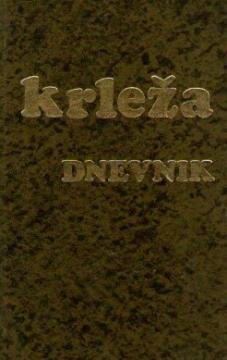
Dnevnik 1: Dnevnik 1914 - 17 (Davni dani I)

Dnevnik 1: Dnevnik 1914 - 17 (Davni dani I)
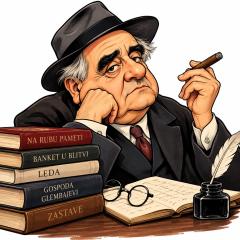
Miroslav Krleža

The 1914–17 diary records Krleža's writings from the First World War: personal dilemmas, pacifism, conflict with the militarism of the Monarchy, and intellectual maturation in the years of the collapse of the old world.

Diary 1914–17 (Davni dani I) is one of the most important autobiographical and documentary texts by Miroslav Krleža, written during the most dramatic years of his life – during World War I. It is an intimate chronicle of the collapse of an era and the maturation of a young intellectual faced with the brutality of militarism and the senselessness of the Austro-Hungarian war machine.

Krleža, then a young cadet, records his experiences in military school, at the front and from his everyday encounter with the military discipline he despises. The diary expresses a strong resistance to the established order: to nationalist pathos, blind obedience and ideological constructs that justify mass suffering. His pacifist, anti-militarist position takes shape through short, sharp, nervous entries in which personal anxiety, intellectual rebellion and deep distrust of the adult world that sends young people to their deaths intertwine.

In addition to the political and moral dimension, the diary also reveals an inner drama: a sense of loneliness, mental turmoil, fears, the first visions of a literary calling. Krleža writes down thoughts on art, philosophy and identity, often in leaping fragments that follow the rhythm of war chaos. These entries announce the themes and style that would later characterize his entire work: a critique of petty-bourgeois ethics, suspicion of “great truths”, a fascination with human suffering and contempt for the rhetoric of power.

At the same time, Diary provides an extremely important historical insight. Through Krleža’s eyes, we see the atmosphere of the collapse of the Monarchy: famine, demoralized soldiers, bureaucratic cruelty, but also intellectual circles trying to think outside the national framework. This collision of reality and reflection creates a text full of tension – at once a document of the times and an emotional-philosophical confession.

Diary 1914–17 thus represents the starting point of Krleža's oeuvre: a book in which his worldview, style, and ethical horizon were shaped, written in the years when the old world was collapsing and the new one did not yet have clear outlines.

Urednik
Anđelko Malinar
Dimenzije
20 x 13 cm
Broj strana
446
Nakladnik
NIŠRO Oslobođenje, Sarajevo, 1981.
 
Latinica. Tvrde korice.
Jezik: Hrvatski.

Jedan primjerak je u ponudi

Stanje:Korišteno, u odličnom stanju
Dodano u košaricu!
 

Zanima Vas i neka druga knjiga? Možete pretražiti našu ponudu pomoću tražilice ili prelistati knjige po kategorijama.

Možda će Vas zanimati i ovi naslovi

Izabrane pjesme

Izabrane pjesme

Miroslav Krleža
Matica hrvatska, 1963.
Hrvatski. Latinica. Tvrde korice s ovitkom.
9,99
Povratak Filipa Latinovicza

Povratak Filipa Latinovicza

Miroslav Krleža

The Return of Filip Latinovicz is one of Miroslav Krleža's most famous novels. This novel is significant in our literature because it is considered the first fully modern Croatian novel.

Večernji list, 2004.
Hrvatski. Latinica. Tvrde korice s ovitkom.
5,52 - 5,56
Hrvatski bog Mars

Hrvatski bog Mars

Miroslav Krleža

The Croatian god Mars brings seven anti-war novels in which Krleža portrays war as a cruel, senseless machinery that destroys the "little man", exposing the hypocrisy of militarism and myths about heroism.

Rad, 1965.
Srpski. Latinica. Broširano.
1,99
Tri sata: Roman međimurskog preokreta 1918.

Tri sata: Roman međimurskog preokreta 1918.

Đuro Vilović

The work, first published in 1935, provides a documentary account of events related to the liberation of Međimurje from Hungarian rule and its annexation to the Kingdom of Serbs, Croats and Slovenes in 1918.

Naklada Binoza, 1935.
Hrvatski. Latinica. Tvrde korice.
7,95
Ranjeni pejzaž

Ranjeni pejzaž

Vladimir Mičetić

A book by Vladimir Mičetić, a doctor and volunteer of the Homeland War from Kutina. The work was awarded the literary prize "We Were the First When It Was Necessary" for 2010, awarded by the Association of Croatian Homeland War Veterans.

Spiritus Movens, 2010.
Hrvatski. Latinica. Tvrde korice.
11,52
Zločin

Zločin

Ivan Potrč

Crime (1955) by Ivan Potrč is a historical novella that focuses on the last days of communist illegals Đuro Đaković and Nikola Hećimović, key figures of the Communist Party of Yugoslavia in the period between the two world wars.

Svjetlost, 1982.
Hrvatski. Latinica. Tvrde korice.
4,28