Fjodor M. Dostojevski
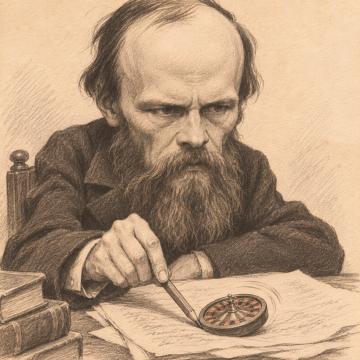
Fyodor Mikhailovich Dostoevsky (Moscow, 1821 – St Petersburg, 1881) reveals the murderer early in Crime and Punishment (1866). The tension builds from what follows. Raskolnikov tries to defend the theory he used to justify the crime, while every conversation with the investigator Porfiry and every meeting with Sonya forces him to face what he has done.
Dostoevsky graduated from a military engineering school in St Petersburg and made his literary reputation with Poor Folk (1846), a novel in letters. Arrested in 1849 for his involvement in the Petrashevsky Circle, he was sentenced to death. He was told that the sentence had been commuted only at the place of execution. He spent four years at hard labour in Omsk and then served as a soldier in Siberia. His prison experience became the material for Notes from the House of the Dead (1860–1862).
In Notes from Underground (1864), the narrator quarrels with an imagined reader and contradicts himself. His voice raises the question of how much people value the freedom to act even against their own interests. In The Gambler (1866), that impulse towards self-sabotage plays out at the roulette table. Working against a contractual deadline, Dostoevsky dictated the novel to the stenographer Anna Snitkina, his future wife.
In The Idiot (1868–1869), Prince Myshkin tries to act with compassion among people who take his sincerity for weakness. In Demons (1871–1872), a small revolutionary group uses political ideas to bind its members to one another. In both novels, the clash of ideas unfolds through what the characters say and do, often during an awkward visit or in the middle of a public scandal.
His final novel, The Brothers Karamazov (1879–1880), grows out of a father’s murder and his son’s trial. Ivan’s story of the Grand Inquisitor brings a question into the family drama: how much freedom are people willing to give up in exchange for security? From a poor clerk’s letters to the Karamazov brothers’ arguments, Dostoevsky gives his characters room to voice even the most uncomfortable reasons for what they believe.
Naslovi u ponudi
Bijedni ljudi / Dvojnik / Roman u devet pisama / Gospodin Proharčin / Gazdarica / Polzunkov / Slabo srce / Pošteni lopov / Božićno drvce i svadba / Tuđa žena i muž pod posteljom
The early works demonstrate Dostoevsky's interest in psychology, social criticism, and moral dilemmas, laying the foundation for later masterpieces. At the end of the book, an appendix by Leonid Grossman: The most important dates in the life and work of F
Braća Karamazovi
„Die Brüder Karamasow“ ist der letzte Roman des russischen Genies Fjodor Michailowitsch Dostojewski, den er weniger als drei Monate vor seinem Tod vollendete.
Pisma iz progonstva / Zimske beleške o letnjim utiscima / Krotka
Fjodor Dostojewski, einer der größten Schriftsteller und Visionäre der Geschichte, wird in dieser Ausgabe mit einer Auswahl aus seinem Briefwechsel (Briefe aus dem Exil), einem Bericht über seine erste Reise nach Europa (Winterliche Aufzeichnungen über So
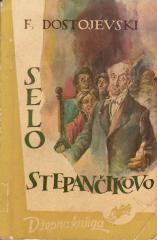
Selo Stepančikovo
„Das Dorf Stepantschikowo“ ist ein humorvoller Roman von Dostojewski, der erstmals 1859 veröffentlicht wurde. Dieser Roman, der sich von den späteren, dunkleren Werken des Autors unterscheidet, ist eine satirische Kritik sozialer Beziehungen und menschlic
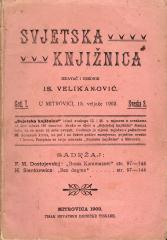
Svjetska knjižnica, Sv. 3.
Die Weltbibliothek, Band 3, herausgegeben von Iso Velikanović, enthält Auszüge aus „Die Brüder Karamasow“ von F. M. Dostojewski und „Ohne Dogma“ von H. Sienkiewicz. Konzipiert für die Selbstbindung einzelner Werke.
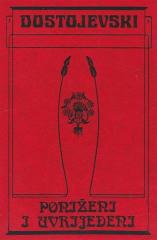
Ujakov san / Poniženi i uvrijeđeni
Zwei Seiten Dostojewskis: eine Satire über gesellschaftlichen Aufstieg durch Heirat und ein bewegender Roman über Liebe, Familienkonflikte und Erniedrigung. Beide untersuchen die Verletzlichkeit des Menschen.
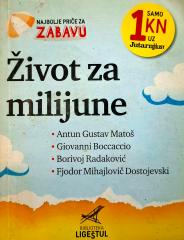
Život za milijune
Die Anthologie „Ein Leben für die Millionen: Die besten Geschichten zur Unterhaltung“ aus dem Jahr 2010 versammelt herausragende Kurzgeschichten bedeutender internationaler und einheimischer Autoren, darunter Matoš, Boccaccio, Radaković und Dostojewski.
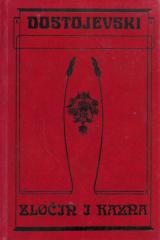
Zločin i kazna
Der Roman „Schuld und Sühne“ (1866) von Fjodor Michailowitsch Dostojewski, ein Meisterwerk der Weltliteratur, ist eine tiefgründige psychologische und philosophische Auseinandersetzung mit Schuld, Moral und Erlösung.