Johann Wolfgang Goethe
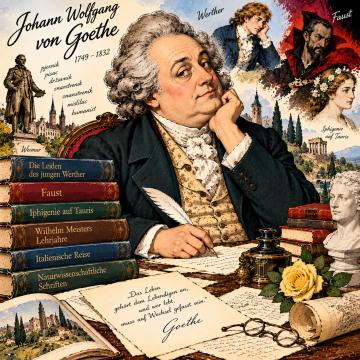
Johann Wolfgang von Goethe (Frankfurt am Main, August 28, 1749 – Weimar, March 22, 1832) was a German poet, writer, playwright, scientist, and statesman, and one of the most significant figures in both German and world literature. He studied law in Leipzig and Strasbourg, where he encountered the ideas of Johann Gottfried Herder. In his youth, he was part of the literary movement known as Sturm und Drang (Storm and Drive), and later, together with Friedrich Schiller, he became a leading figure of Weimar Classicism.
He achieved literary fame with the play Götz von Berlichingen (1773) and the epistolary novel The Sorrows of Young Werther (Die Leiden des jungen Werthers, 1774), which exerted a profound influence on European Romanticism. In the novel, he explores unhappy love, the conflict between emotions and social conventions, and the tragic fate of a sensitive individual. In 1775, he moved to Weimar, where he held high-ranking state positions and pursued a wide range of cultural and scientific interests. Among his most significant works are the plays Iphigenia in Tauris (Iphigenie auf Tauris, 1787), Egmont (1788), and Torquato Tasso (1790); the novels Wilhelm Meister's Apprenticeship (Wilhelm Meisters Lehrjahre, 1795–1796) and Elective Affinities (Die Wahlverwandtschaften, 1809); and the autobiographical work Poetry and Truth (Dichtung und Wahrheit, 1811–1833). His greatest achievement, the tragedy Faust (Part One, 1808; Part Two, posthumously in 1832), represents a philosophical and poetic synthesis of the human striving for knowledge, power, love, and the meaning of existence.
Goethe was also a notable natural scientist, with a particular interest in botany, anatomy, and optics. He published the scientific treatises The Metamorphosis of Plants (Versuch die Metamorphose der Pflanzen zu erklären, 1790) and Theory of Colours (Zur Farbenlehre, 1810). His journey through Italy (1786–1788) profoundly shaped his classicist worldview; he chronicled this experience in the work Italian Journey (Italienische Reise, 1816–1817).
Goethe’s body of work is characterized by humanism, universality, philosophical depth, and a striving for harmony between nature, art, and humanity. His rich literary and scientific work has permanently marked the development of European culture and ranks him among the greatest literary creators of all time.
Naslovi u ponudi
Egmont: Tragedija u pet činova
Goethe’s tragedy depicts Count Egmont’s struggle against Spanish tyranny in the 16th-century Netherlands. His devotion to freedom and the people leads to a conflict with the authorities, imprisonment, and a tragic death.

Faust
Johann Wolfgang von Goethe's "Faust" is one of the most important works of world literature. This monumental two-part philosophical and poetic poem explores profound questions of human existence, morality, knowledge, happiness, and destiny.

Izabrane pjesme / Ausgewählte Gedichte
A representative selection from the lyrics of Goethe, one of the greatest European poets, encompassing key phases of his work – from Sturm und Drang, through the classical Weimar period to his late poems.
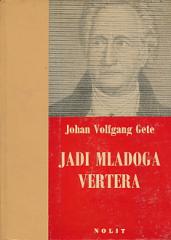
Jadi mladoga Vertera
Goethe's masterpiece of an epistolary novel from 1774 (revised in 1787), pivotal to the Sturm und Drang movement, caused a cultural upheaval in Europe – a wave of suicides, "Wertherism" and the imitation of heroes in fashion and sentiment.