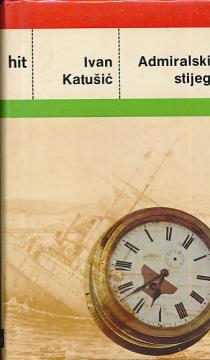
Admiralski stijeg

Admiralski stijeg

Ivan Katušić

I define the novel as neo-historical, written exactly according to an established outline like other neo-historical novels; by inserting fictitious characters and events into a well-known, factual, historical framework.

The novel Admiralski stijeg stands out for its abundance of metatextual elements that have their own purpose, which the reader is forced to perceive and interpret. Metatextual elements will be analyzed in detail in this paper with the aim of explaining metatextuality in general and its interpretation in the novel Admiralski stijeg. In addition, metatextuality is broken down into open and actualized forms of diegetic, i.e., linguistic self-awareness, and I describe the realization of each individual form in the work of Ivan Katušić. In addition, I will explain metatextuality as a concept and explain the views of literary theorists who are interested in this area. The thesis is structured in such a way that the first chapter presents an introduction to the center of his profession. Before the actual analysis of Katušić's novel, the literary work of Ivan Katušić was presented in the second chapter. Furthermore, they are in the third chapter presented the main characteristics of the new historical novel and Admiralski stijeg as a new historical novel. The area of interest in the fourth chapter is the explanation of the concept of metatextuality and the viewpoints of literary theorists. Some of the experts who study metatextuality and its occurrence in literary works, and are mentioned in this paper, are Linda Hutcheon, William H. Gass and Patricia Waugh. The fifth chapter can also be considered the most important chapter of this work. It presents a detailed analysis of Ivan Katušić's novel Admiralski stijeg and observed metatextual elements, which is the ultimate goal and purpose of this of work. Each of the metatextual forms is described separately, its purpose is explained and it is thoroughly supported by quotations from the book Admiralski stijeg. The final chapter summarizes everything previously written in the paper and my own conclusions related to the mentioned topic.

Editor
Zlatko Crnković
Illustrations
Dražen Pomykalo
Graphics design
Alfred Pal, Dražen Pomykalo
Dimensions
19.5 x 12 cm
Pages
273
Publisher
Znanje, Zagreb, 1987.
 
Distribution: 6,000 copies
 
Latin alphabet. Hardcover with dust jacket.
Language: Croatian.
ISBN
8-63-130101-9

No copies available

The last copy was sold recently.


Are you interested in another book? You can search the offer using our search engine or browse books by category.

You may also be interested in these titles

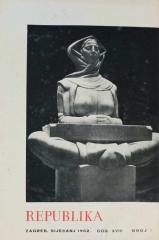
Republika 1962/1

Republika 1962/1

Gustav Krklec, Petar Šegedin, Miroslav Vaupotić, Dobriša Cesarić, Ivan Katušić, Marin Franičević,...
Zora, 1962.
Croatian. Latin alphabet. Paperback.
6.82
Liber memorabilium

Liber memorabilium

Ivan Lovrenović

Summarizing numerous sources with a strong authorial gesture, while retaining their own characteristics, Lovrenović composed a book documenting (a 'forbidden') history, not suspecting that he was writing an epitaph!

Durieux, 1994.
Croatian. Latin alphabet. Paperback.
7.945.96
Dijalektika prijelaznog perioda

Dijalektika prijelaznog perioda

Viktor Pelevin

The book represents the author's anthology - the largest part is the novel Čisla (Čisla), followed by the short story Macedonian Criticism of French Thought and several short stories (Odin vog, Akiko, Fokus-grupa, Gost na prazniku bon).

Disput, 2006.
Croatian. Latin alphabet. Paperback.
9.68
Poziv na pogubljenje

Poziv na pogubljenje

Vladimir Nabokov

Es besteht kein Zweifel, dass „Der Ruf zur Hinrichtung“ am reizvollsten ist, wenn man ihn so liest, wie er geschrieben wurde – als anti-utopischen oder anti-totalitären Roman…

Nolit, 1988.
Serbian. Latin alphabet. Hardcover with dust jacket.
12.32
Svjetlost se ugasila

Svjetlost se ugasila

Rudyard Kipling

Der erste Roman des englischen Nobelpreisträgers Rudyard Kipling (1865–1936), zuerst veröffentlicht im Lippincott's Monthly Magazine (Variante mit Happy End) und dann in einer Buchfassung mit tragischem Ende.

Zora, 1957.
Croatian. Latin alphabet. Hardcover with dust jacket.
5.42
Pažnja

Pažnja

Alberto Moravia

Francesco Merighi kehrt nach neun Jahren im Ausland nach Rom zurück. Um einen „authentischen“ Roman zu schreiben, führt er Tagebuch über sein Leben mit seiner Frau und seiner Tochter Babe. Er analysiert obsessiv Lügen in Be

Otokar Keršovani, 1966.
Croatian. Latin alphabet. Hardcover.
3.96