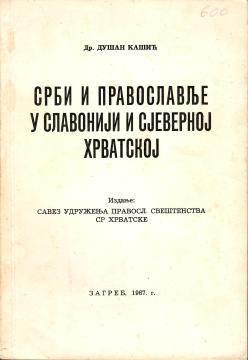
Srbi i pravoslavlje u Slavoniji i sjevernoj Hrvatskoj

Srbi i pravoslavlje u Slavoniji i sjevernoj Hrvatskoj

Dušan Lj. Kašić

"Serbs and Orthodoxy in Slavonia and Northern Croatia" by Dušan Kašić is a historical and sociological work that analyzes the history, culture and religious life of Orthodox Serbs in Slavonia and northern Croatia.

The book deals with the identity of Serbs of the Orthodox faith in this part of Croatia through historical development, from the arrival of Orthodox communities in these areas to their position in modern social circumstances.

Kašić describes in detail the historical context of the arrival of Orthodox Serbs in Slavonia and northern Croatia. Certain waves of settlement are connected with the Turkish conquests during the 16th and 17th centuries and the Habsburg Monarchy, which provided Orthodox settlers with certain privileges through the Statute of 1690. Orthodox Serbs were an important part of the Military Border system, where they served as border guards and at the same time developed their own religious and cultural institutions.

The author investigates the role of the Serbian Orthodox Church in preserving the national and religious identity of the Serbs in this area. Kašić describes the construction and significance of Orthodox temples and monasteries, which were centers of spiritual and cultural life. The role of the church extends to education and the spread of literacy, with Orthodox schools playing a key role in preserving language and tradition.

The book analyzes mutual relations between Orthodox Serbs and other ethnic and religious groups in Slavonia and northern Croatia. Although there were conflicts, especially during periods of national tension in the 19th and 20th centuries, the author also points to periods of mutual coexistence and cooperation. Special emphasis is placed on the influence of political changes and wars on the position of Serbs and their religious communities, including the period of the Kingdom of Yugoslavia, NDH and socialist Yugoslavia.

Editor
Ratko Jelić
Maße
20 x 13,5 cm
Seitenzahl
140
Verlag
Savez udruženja pravoslavnog sveštenstva SR Hrvatske, Zagreb, 1967.
 
Kyrillisch Schrift. Taschenbuch.
Sprache: Kroatisch.

Im Angebot sind keine Exemplare vorhanden

Das letzte Exemplar wurde kürzlich verkauft.


Interessieren Sie sich für ein anderes Buch? Sie können das Angebot über unsere Suchmaschine suchen und finden oder Bücher nach Kategorien durchsuchen.

Diese Titel könnten Sie auch interessieren

Matica hrvatskih umirovljenika - Gradsko udruženje Osijek 1946-1996.

Matica hrvatskih umirovljenika - Gradsko udruženje Osijek 1946-1996.

Vinko Žiroš, Jaroslav Bouše, Marija Vukelić, Miroslav Kasabašić, Šešo Marija
Gradsko udruženje, 1996.
Kroatisch. Latein Schrift. Taschenbuch.
2,42
U logorima Manjače i Gline

U logorima Manjače i Gline

Vladimir Štefanac

In den Lagern Manjača und Glina: Zeugnisse kroatischer Veteranen Dies ist das zweite Buch von Vladimir Štefanac und erzählt von den Kämpfen in Kostajnica und der Inhaftierung in Manjača.

Consilium, 1996.
Kroatisch. Latein Schrift. Taschenbuch.
9,987,98
Štrajk glađu

Štrajk glađu

Božo Rudež
Tonimir, 1995.
Kroatisch. Latein Schrift. Taschenbuch.
3,98 - 3,99
Branimirova Hrvatska u pismima pape Ivana VIII.

Branimirova Hrvatska u pismima pape Ivana VIII.

Mate Zekan
Književni krug, 1989.
Kroatisch. Latein Schrift. Taschenbuch.
4,39
Živjeti u Hrvatskoj: Zapisci iz nepovrata 1900 - 1941.

Živjeti u Hrvatskoj: Zapisci iz nepovrata 1900 - 1941.

Horvat
Josip Horvat

Das Buch stellt eine persönliche Chronik der kroatischen Geschichte in der ersten Hälfte des 20. Jahrhunderts dar. Es wurde von Josip Horvat mit der Absicht verfasst, die sozialen, politischen und kulturellen Veränderungen zu dokumentieren, die Kroatien z

Sveučilišna naklada Liber (SNL), 1984.
Kroatisch. Latein Schrift. Fester Einband mit Schutzumschlag.
17,24
Tumač obćemu austrijskomu gradjanskomu zakoniku I - II

Tumač obćemu austrijskomu gradjanskomu zakoniku I - II

Adolf Rušnov

Das 1811 veröffentlichte Allgemeine österreichische Zivilgesetzbuch stellt nach dem berühmten französischen Code Civil von 1804 die zweite bedeutende Kodifizierung des Zivilrechts in Europa dar. OGZ in Kroatien und Slawonien wurde 1852 eingeführt, als das

Knjižarnica Lavoslava Hartmana, 1891.
Kroatisch. Latein Schrift. Hardcover.
Das Buch besteht aus zwei Bänden
130,00