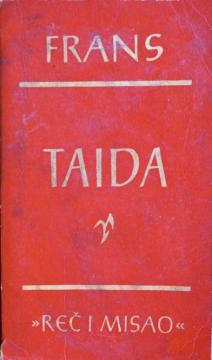
Taida: roman iz aleksandrijskih vremena

Taida: roman iz aleksandrijskih vremena

Anatole France

The novel Taida, published in 1890, is one of the most famous works by French Nobel Prize winner Anatole France. The work is inspired by the legend of Saint Taida of Egypt, a 4th-century courtesan who converted to Christianity.

The novel follows Paphnutius, an ascetic monk living in the Egyptian desert. Inspired by a vision, he decides to save Taida, a famous Alexandrian courtesan, from her sinful life. Paphnutius travels to Alexandria, where, disguised as a wealthy young man, he approaches Taida and manages to convert her to Christianity. Together they return to the desert, where Taida begins a life of penance in a monastery under the guidance of the nun Albina.

However, Paphnutius increasingly struggles with his own feelings for Taida. While she sincerely seeks spiritual purification, he faces an internal conflict between his faith and his growing carnal desire. In the end, when Taida dies in a state of spiritual ecstasy, Paphnutius confesses his love for her and expresses doubts about her faith, revealing his own spiritual crisis.

Taida is a philosophical novel that explores themes of spirituality, temptation, repentance, and inner conflict. France uses historical context to critically reflect on religion, morality, and human nature, often with a touch of irony and skepticism. The work also served as inspiration for Jules Massenet's 1894 opera Thaïs.

Original title
Thaïs
Translation
Nikola Lalić
Dimensions
18 x 10.5 cm
Pages
157
Publisher
Rad, Beograd, 1961.
 
Latin alphabet. Paperback.
Language: Serbian.

One copy is available

Condition:Used, good condition (visible signs of use)
Damages or inconvenience notice:
  • Yellowed pages
 

Are you interested in another book? You can search the offer using our search engine or browse books by category.

You may also be interested in these titles

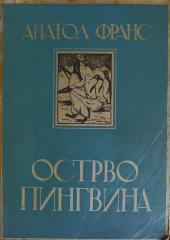
Ostrvo pingvina

Ostrvo pingvina

Anatole France
Kultura, 1946.
Serbian. Cyrillic alphabet. Paperback.
3.99
Mali Pjer

Mali Pjer

Anatole France
Novo pokolenje, 1950.
Serbian. Cyrillic alphabet. Paperback with dust jacket.
2.99
Kako to reći Liddy: jetka komedija

Kako to reći Liddy: jetka komedija

Anne Fine

Imagine four sisters who share everything from shopping marathons and family dinners to the most intimate secrets. Heather, Bridie, Stella and Liddy Palmer – unbreakable, loyal, impenetrable. Or so they think...

Znanje, 1998.
Croatian. Latin alphabet. Paperback.
3.46
Usta puna zemlje

Usta puna zemlje

Branimir Šćepanović
BIGZ, 1977.
Serbian. Latin alphabet. Paperback.
4.26
Proljetne vode

Proljetne vode

Ivan Sergejevič Turgenjev

During his stay in Mainz, the young Russian nobleman Sanjin meets the beautiful Italian Gemma, with whom he falls in love.

Logos, 1985.
Croatian. Latin alphabet. Hardcover with dust jacket.
3.98
Pozlaćenje demona

Pozlaćenje demona

Ozaki Kohio

The novel shows the price that society pays as a result of modernization, when the power of money overcomes human affection and social responsibility. This is a novel by one of the most prominent and influential Japanese writers.

Minerva, 1984.
Serbian. Latin alphabet. Hardcover with dust jacket.
5.28