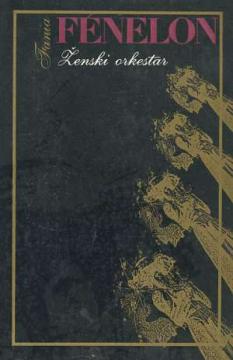
Ženski orkestar
Retka knjiga

Ženski orkestar

Fania Fenelon

Fanie Fénelon's novel The Women's Orchestra is a memoir that describes her experience of surviving in a women's orchestra at the Auschwitz-Birkenau concentration camp during World War II.

Fania, born Fanny Goldstein, a Parisian cabaret singer and member of the Resistance, was arrested in 1943 as a Jew and deported to Auschwitz and later to Bergen-Belsen. In the Birkenau camp, under the number 74862, she joined a women's orchestra led by Alma Rosé, Gustav Mahler's niece.

The orchestra, made up of women of various nationalities, played for the SS and prisoners, often under duress, in order to survive. Fania, a pianist and singer, describes the horrors of the camp - death, humiliation, hunger - but also the dark humor, love, hatred and solidarity among the members of the orchestra. The novel explores moral compromises, tensions between prisoners, including the anti-Semitism of some Polish women, and complex relationships with Nazis, such as Dr. Mengele. Music becomes a means of survival, but also a source of spiritual resistance.

Fénelon writes without pathos, with humor and sincerity, recording trauma and strength of spirit. Although some members of the orchestra, such as Anita Lasker-Wallfisch, challenged her portrayal of Alma Rosé and the dynamics in the orchestra, the work remains a powerful document on the Holocaust, translated into multiple languages and adapted into the film Playing for Time (1980).

Naslov originala
Sursis pour l'orchestre
Prevod
Višnja Machiedo
Urednik
Mirjana Buljan
Dimenzije
20 x 14 cm
Broj strana
372
Izdavač
Globus, Zagreb, 1985.
 
Latinica. Tvrde korice s omotom.
Jezik: Hrvatski.

Jedan primerak je u ponudi

Stanje:Korišćeno, u odličnom stanju
Dodato u korpu!
 

Zanima Vas i neka druga knjiga? Možete pretražiti našu ponudu pomoću pretrage ili prelistati knjige po kategorijama.

Možda će Vas zanimati i ovi naslovi

Sarajevski Marlboro / Karivani / Druge priče, 1992–1996

Sarajevski Marlboro / Karivani / Druge priče, 1992–1996

Miljenko Jergović

Along with the reissues of "Sarajevo Marlboro" and "Karivan", the book also contains a new cycle of stories by this author. These stories vividly portray characters, "little" people, witnesses of "big" history, and seemingly insignificant, but for them pi

Durieux, 1999.
Hrvatski. Latinica. Broširano.
14,72
Zaboravljene djevojke

Zaboravljene djevojke

Martha Hall Kelly

The novel The Forgotten Girl is based on the real life of a member of New York's posh circles, who fought for the rights of Kunić, a group of women who survived the horrors of the Ravensbrück concentration camp.

Mozaik knjiga, 2018.
Hrvatski. Latinica. Broširano.
7,98 - 8,42
Osmi patuljak

Osmi patuljak

Milan Krmpotić

Roman donosi priču o mladiću koji, razočaran stereotipima svakodnevnog života, teži ostvariti vlastitu bajku. U potrazi za smislom, suočava se s paradoksalnim i tragikomičnim situacijama, gubeći dodir sa stvarnošću.

Otokar Keršovani, 1997.
Hrvatski. Latinica. Tvrde korice.
13,32
Baraka Pet Be i druge novele

Baraka Pet Be i druge novele

Miroslav Krleža

Die Sammlung "Baraka Pet Be i druge novele" enthält eine Auswahl von Krležas Antikriegsromanen aus der Zeit von 1916 bis 1920, die sich mit der Sinnlosigkeit des Ersten Weltkriegs, dem Leid der Heimwehr und dem Untergang Österreich-Ungarns auseinandersetz

Mladost, 1987.
Hrvatski. Latinica. Tvrde korice.
5,38
Sanjaj nemogući san

Sanjaj nemogući san

Johannes Mario Simmel

Vom Bestsellerautor von „Jimmy und der Regenbogen“ stammt ein Roman, der eine Liebesgeschichte mit den bewegenden Ereignissen des Bosnienkrieges verknüpft. Diese Geschichte, eingebettet in den historischen Kontext, erinnert uns daran, dass manchmal der un

Mozaik knjiga, 1997.
Hrvatski. Latinica. Tvrde korice.
7,42
Čočara

Čočara

Alberto Moravia

Die Witwe Cesira und ihre Tochter Rosetta fliehen aus dem bombardierten Rom in ihre Heimat Ciociaria, wo sie Hunger, Angst und Elend erleben. Die Befreiung bringt eine Tragödie: Rosetta wird von marokkanischen Soldaten vergewaltigt, was ihren Glauben an G

Otokar Keršovani, 1966.
Hrvatski. Latinica. Tvrde korice.
3,96