Po-etika, knjiga druga
Rare book

Po-etika, knjiga druga

Danilo Kiš

A collection of interviews that complements the first book of essays from 1972. As a lecturer in Serbo-Croatian at the University of Bordeaux, Kiš reveals in conversations the core of his "po-ethics" - a morally and aesthetically charged vision of literat

Quote from the book: "art is... still the last instance, the last refuge of the human spirit. When everyone roars with their pig hearts, the last ones who will still see with human eyes and feel with a human heart will be those who were no stranger to the experience of art."

Born in Subotica in 1935 in a mixed Jewish-Montenegrin family, Kiš lost his father Eduard in Auschwitz in 1944, which profoundly shaped his worldview: themes of death, trauma, identity and history permeate his oeuvre, from "Sandman" (1972) to "Tomb for Boris Davidovič" (1976). In interviews, inspired by Nabokov and the Russian formalists (Shklovsky, Eichenbaum), he advocates palimpsest – layered erasure and rewriting of the text to an absolute, albeit elusive principle. He criticizes "autopastiche" (self-return) and generalizing criticism, preferring fragmentation, irony and depersonalization to lyrical sentimentalism or ideological programs. His poetics is "unhappy and resigned": unhappy with the inconsistency of demands, resigned to their unattainability, but persistent in the face of biographical "capture" (Sartre) and anxiety before death.

The book contains discussions on influences (Prust, Andrić), literary form (from first to third person, fragments in "Peščanik" with 67 parts), politics (rejection of socialist realism, fight against injustice without ideology) and existential questions. Later, parts were included in "Homo poeticus" (1983), Kiš's selection of essays and interviews, while the whole was published posthumously in "Skladište" (1995). As a symbol of intellectual resistance, "Po-Ethics" influenced European literature, translated into numerous languages, emphasizing literature as a question, not an answer – in a world where history devours the individual. Kiš, who died in 1989 in Paris, remains a voice opposed to oblivion: "Counting is a talisman against death."

Graphics design
Nenad Čonkić
Dimensions
16.5 x 10 cm
Pages
188
Publisher
Ideje, Beograd, 1974.
 
Latin alphabet. Paperback.
Language: Serbian.

One copy is available

Condition:Used, excellent condition
 

Are you interested in another book? You can search the offer using our search engine or browse books by category.

You may also be interested in these titles

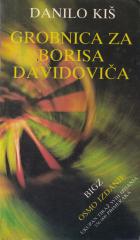
Grobnica za Borisa Davidoviča

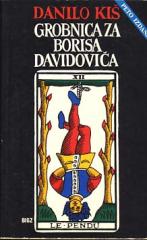
Grobnica za Borisa Davidoviča

Danilo Kiš

Today, some fifty years after the first printing, A Tomb for Boris Davidovich is considered one of the best prose books published in the former Yugoslavia, and it has become part of the world literary canon.

BIGZ, 1989.
Serbian. Latin alphabet. Paperback.
7.32
Zapisi iz mrtvog doma / Zimske bilješke o ljetnim dojmovima / Zapisi iz podzemlja

Zapisi iz mrtvog doma / Zimske bilješke o ljetnim dojmovima / Zapisi iz podzemlja

Fjodor Mihajlovič Dostojevski

Notes from a Dead Home (1860-1862) - a novel based on the author's imprisonment in Siberia. Winter Notes on Summer Impressions (1863) - an essay from a trip to Europe in 1862. Notes from the Underworld (1864) is a philosophical novel about a man torn by i

Znanje, 1982.
Croatian. Latin alphabet. Hardcover.
16.56
Nasljednik indijskog cara : Jakša Kušan od 1500. godine pr. Kr. do 1980.

Nasljednik indijskog cara : Jakša Kušan od 1500. godine pr. Kr. do 1980.

Ivan Kušan

Autobiographical prose by Ivan Kušan, in which the author tells the story of the life of his father, Jakša Kušan, from a personal and family perspective. Through Ivan Kušan's memories, we follow Jakša Kušan in pre-war Sarajevo, wartime and post-war Zagreb

Naklada Ljevak, 2000.
Croatian. Latin alphabet. Paperback.
4.76
Pjesnik govori: filozofsko-estetske kozerije

Pjesnik govori: filozofsko-estetske kozerije

Drago Ćepulić

"The Poet Speaks: Philosophical-Aesthetic Riddles" by Dragutin (Drago) Ćepulić is a collection of short, thoughtful essays in which the author reflects on literature, art, philosophy, and human creativity in a witty, insightful, and unobtrusive manner.

Minerva nakladna knjižara, 1943.
Croatian. Latin alphabet. Paperback.
6.24
Moj Argentinski Tango - ispovest Mornara Pešića

Moj Argentinski Tango - ispovest Mornara Pešića

Predrag Aleksijević

The book is an authentic, poignant, and humorous confession of the Belgrade sailor and bohemian Milorad Mornar Pešić (1934–2018), which Predrag Aleksijević wrote down and shaped into a confessional novel.

NIRO Exportpress, 1984.
Serbian. Latin alphabet. Paperback with dust jacket.
5.26
Maske / Lutanja

Maske / Lutanja

Juš Kozak
Naprijed, 1963.
Croatian. Latin alphabet. Hardcover.
5.46