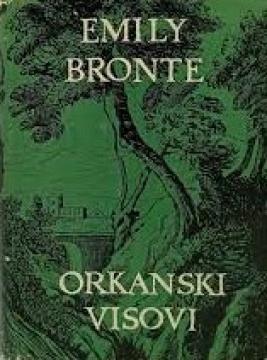
Orkanski visovi

Orkanski visovi

Emily Bronte

A first-class "sweetheart" and an unquestionable classic - this is the generally accepted perception of the reading public and critics of the famous novel by Emily Brontë from 1847, which, with its special quality and popularity, significantly surpasses t

Wuthering Heights is a relatively early outgrowth of Victorian literature and a relatively late reflection of the so-called of the Gothic tradition, so the surroundings are somewhat "darker", but nevertheless, the almost supernatural glow of love shines through it, which, despite everything, even death, lives forever. This book, it seems, will live forever, mostly because of the intense and hitherto unconceived emotional drama that Emily Brontë described unusually powerfully and convincingly. It is interesting that the novel with such a "hurricane" dramatic charge and complex psychological characterization of the characters - first of all, the demonic nature of the main character Heathcliff, who expresses an unprecedented force of anger, rage and depravity - was written by a girl of less than thirty summers, who will end her short life just after completing his only work. Thus, the fragile health of the girl left behind an immortal book that "vampirically" comes to life every now and then through numerous new editions, adaptations, reinterpretations or quotations in film, comics, music, literature... - let's remember Bunuel's treatment in the film Abyss of Passion from 1954, or the more hyped of Kate Bush's musical "reading" in the 1978 hit Wuthering Heights, while younger readers are rediscovering her through Stephenie Meyer's hyper-popular Twilight series.

Original title
Wuthering Heights
Translation
Živojin Simić, Franjo Hartl
Graphics design
Boris Dogan
Dimensions
20 x 15 cm
Pages
351
Publisher
Naprijed, Zagreb, 1965.
 
Latin alphabet. Hardcover with dust jacket.
Language: Croatian.

Two copies are available

Copy number 1

Condition:Used, excellent condition

Copy number 2

Condition:Used, very good condition
Damages or inconvenience notice:
  • The cover is missing
 

Are you interested in another book? You can search the offer using our search engine or browse books by category.

You may also be interested in these titles

Orkanski visovi

Orkanski visovi

Emily Bronte

A first-class "sweetheart" and an unquestionable classic - this is the generally accepted perception of the reading public and critics of the famous novel by Emily Brontë from 1847, which, with its special quality and popularity, significantly surpasses t

Naprijed, 1967.
Croatian. Latin alphabet. Hardcover with dust jacket.
7.52
Orkanski visovi

Orkanski visovi

Emily Bronte

A first-class "sweetheart" and an unquestionable classic - this is the generally accepted perception of the reading public and critics of the famous novel by Emily Brontë from 1847, which, with its special quality and popularity, significantly surpasses t

Večernji list, 2004.
Croatian. Latin alphabet. Hardcover with dust jacket.
6.54
Orfejeva oporuka - od moderne do postmoderne

Orfejeva oporuka - od moderne do postmoderne

Branka Brlenić Vujić
Matica hrvatska, 2004.
Croatian. Latin alphabet. Paperback.
3.99
Mudroslovna Tereza

Mudroslovna Tereza

Therese the Wise (1748) is an erotic novel by an anonymous author (probably the Marquis d'Argens), mixing the philosophy of the Lumières with explicit scenes. With an introduction by Michel Camus and a foreword by Philippe Roger.

Logos, 1988.
Croatian. Latin alphabet. Hardcover with dust jacket.
7.36
Velike porodice

Velike porodice

Maurice Druon

Big families is Drion's best novel. In it, the writer, in a very vivid and striking way, gave a cross-section of French society after the First World War: some characters of the novel become like living witnesses of their time.

Kosmos, 1960.
Serbian. Latin alphabet. Hardcover with dust jacket.
6.54
Starac i more

Starac i more

Ernest Hemingway

The Old Man and the Sea possesses the artistic power of a biblical story or parable.

Seljačka sloga, 1952.
Croatian. Latin alphabet. Paperback.
4.32