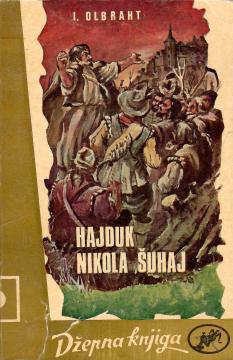
Hajduk Nikola Šuhaj
Ein rares Buch

Hajduk Nikola Šuhaj

Ivan Olbracht

Hajduk Nikola Šuhaj (1933) is the most famous novel by Ivan Olbracht (real name Kamil Zeman, 1882–1952), a classic of 20th-century Czech literature. One of the most important works of Czech literature between the two wars.

The novel is set in Subcarpathian Russia (today Ukraine, Transcarpathian Oblast) after World War I and the collapse of Austria-Hungary. The main character Nikola Šuhaj, a young peasant from the village of Kolochava, returns from the front. Due to poverty, injustice from landowners and the authorities, and the impossibility of a normal life, he becomes a hajduk – a bandit. He begins to rob rich Jews, merchants and Chetniks, but distributes the money to poor peasants, which makes him a folk hero and the Robin Hood of the Carpathians.

Olbracht subtly depicts social contrasts: the poverty of the Ruthenian peasants, corruption of the authorities, anti-Semitism and exploitation. Nikola is not idealized – he is brave, but also violent, and his life is full of danger. The novel culminates in betrayal: in 1921, his comrades kill him for a reward, and his head is cut off and displayed as a trophy.

The style is realistic with elements of folk legend and ballad: the author uses folklore motifs, dialectal expressions and an epic tone, creating a myth about a righteous bandit. The work is anti-war and socially critical, but without agitation - the emphasis is on the tragic fate of the individual in the chaos of post-war society.

The novel was a great success, was screened several times (eg the movie "Nikola Šuhaj loupežník" in 1978, directed by Jiří Sequens), and became part of the folk mythology of Transcarpathia. In Yugoslavia, it was popular in post-war editions, appreciated for its humanism and realistic portrayal of peasant life.

Titel des Originals
Nikola Šuhaj loupežník
Übersetzung
Zora Simić
Editor
Risto Trifković
Titelseite
Mirko Stojnić
Maße
16,5 x 11 cm
Seitenzahl
213
Verlag
Svjetlost, Sarajevo, 1965.
 
Latein Schrift. Taschenbuch.
Sprache: Kroatisch.

Angeboten wird ein Exemplar

Zustand:Ungebraucht
Zum Warenkorb hinzugefügt!
 

Interessieren Sie sich für ein anderes Buch? Sie können das Angebot über unsere Suchmaschine suchen und finden oder Bücher nach Kategorien durchsuchen.

Diese Titel könnten Sie auch interessieren

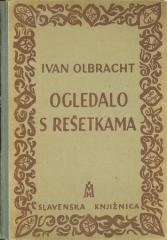
Ogledalo s rešetkama

Ogledalo s rešetkama

Ivan Olbracht

"Mirror with bars" by Ivan Olbracht is a novel that deals with the themes of identity, love and social norms through the story of the life and internal conflicts of the main character, Milan. (Author's real name: Kamil Zeman.)

Matica hrvatska, 1946.
Kroatisch. Latein Schrift. Hardcover.
2,99 - 4,76
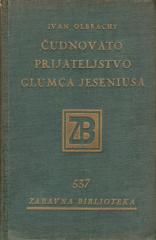
Čudnovato prijateljstvo glumca Jeseniusa

Čudnovato prijateljstvo glumca Jeseniusa

Ivan Olbracht

Ivan Olbracht's story follows the actor Jesenius, who prepares for the role of Jan Jesenius and, by identifying with him, gradually becomes psychologically destabilized and loses his sense of his own identity.

Naklada zaklade tiskare Narodnih novina, 1933.
Kroatisch. Latein Schrift. Hardcover.
6,46
Tako svršava

Tako svršava

Zvonimir Remeta

A novel that thematizes the family complex, tense and unhealthy relationship between people, especially between parents and children.

Matica hrvatska, 1943.
Kroatisch. Latein Schrift. Taschenbuch.
6,42
Shirley

Shirley

Charlotte Bronte

The novel Shirley (1849) is Charlotte Brontë's second social novel after Jane Eyre, depicting the industrial crisis caused by the Napoleonic Wars and the blockade of trade, where machines replace workers, causing discontent and violence.

Matica hrvatska, 1974.
Kroatisch. Latein Schrift. Fester Einband mit Schutzumschlag.
6,32
Opustošena zemlja

Opustošena zemlja

Alexander Cordell
Mladost, 1964.
Kroatisch. Latein Schrift. Fester Einband mit Schutzumschlag.
5,724,81 - 6,425,72
I ne reče ni reči

I ne reče ni reči

Heinrich Böll

In Boll's novels, one of the central themes is the attempt to preserve basic moral values ​​in a time of terror, as well as in a period of material prosperity and corruption.

Svjetlost, 1965.
Serbisch. Latein Schrift. Taschenbuch.
3,22 - 3,98