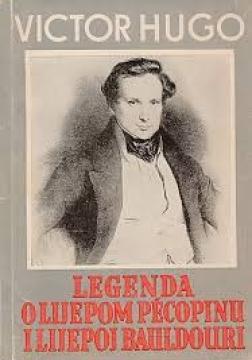
Legenda o lijepom Pécopinu i lijepoj Bauldouri

Legenda o lijepom Pécopinu i lijepoj Bauldouri

Victor Hugo

A romantic story by Victor Hugo, the 21st letter from his travelogue "Le Rhin" ("The Rhine", 1842). A romantic classic, similar to the fairy tales of the Brothers Grimm or Andersen, but with Hugo's deep emotionality and philosophy of eternal love.

The story takes place in medieval Germany, in a romantic, fairy-tale landscape along the Rhine. The handsome young knight Pecopin and the beautiful Bauldour have been in love with each other since childhood; their fathers have betrothed them. On their wedding day, Pecopin goes hunting for a huge boar that is terrorizing the village. In pursuit, the devil (in the form of a boar or a hunter) lures him into an enchanted forest, where time stops flowing normally: Pecopin hunts for centuries, goes through ages, wars and changes, but cannot return.

After 100 years, Pecopin finally returns – old, exhausted, but still in love. He finds Bauldour: she has waited faithfully, but has died of grief and old age. In the dramatic finale, love conquers death – Pecopin finds her in the grave, and the spirits are united in eternity.

Hugo uses folkloric motifs (the eternal hunt, the devil's illusion, the Rhine as a symbol of transience) to create a romantic fairy tale about love that transcends time, death, and fate. The story is lyrical, full of poetic descriptions of nature, medieval chivalry, and melancholy – typical of Hugo's style in "Le Rhin," where he mixes travelogue, history, and fiction.

Naslov izvornika
Légende du beau Pécopin et de la belle Bauldour
Prijevod
Kruno Ilić
Urednik
Gustav Krklec
Dimenzije
16,5 x 12 cm
Broj strana
81
Nakladnik
Zora, Zagreb, 1951.
 
Latinica. Broširano.
Jezik: Hrvatski.

Jedan primjerak je u ponudi

Stanje:Korišteno, u odličnom stanju
Dodano u košaricu!
 

Zanima Vas i neka druga knjiga? Možete pretražiti našu ponudu pomoću tražilice ili prelistati knjige po kategorijama.

Možda će Vas zanimati i ovi naslovi

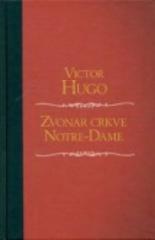
Zvonar crkve Notre-Dame

Zvonar crkve Notre-Dame

Victor Hugo

Hugos Roman über das mittelalterliche Paris am Ende des 15. Jahrhunderts, geschrieben im Geiste der Romantik. Es ist ein Roman menschlicher Leidenschaften, ein Roman über drei unglückliche Lieben, aber vor allem ein Epos über die Kathedrale als „Hauptfigu

Jutarnji list, 2005.
Hrvatski. Latinica. Tvrde korice.
8,54
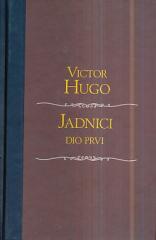
Cosette, Gavroche

Cosette, Gavroche

Victor Hugo
Mladost, 1971.
Hrvatski. Latinica. Tvrde korice.
6,22 - 6,64
Zvonar bogorodičine crkve

Zvonar bogorodičine crkve

Victor Hugo

Der Glockenturm (1831) ist nicht nur eine Geschichte von Liebe und Tragödie – er ist ein lebendiges Bild von Paris an der Schwelle zur Renaissance, wo die gotische Kathedrale Notre-Dame beinahe zur Hauptfigur wird, zu einem lebendigen Wesen aus Stein, das

Svjetlost, 1973.
Srpski. Latinica. Tvrde korice.
Knjiga se sastoji od dva toma
7,38
Najbolje ljubavne priče

Najbolje ljubavne priče

Eine Anthologie kurzer Liebesgeschichten aus der Weltliteratur, ausgewählt für ein breites Publikum im sozialistischen Jugoslawien. Hadžićs Auswahl zeichnet sich durch Qualität und Vielfalt aus und ist damit ein wertvolles Beispiel jugoslawischer Populärl

Novinarsko izdavačko poduzeće, 1961.
Hrvatski. Latinica. Broširano.
4,36 - 4,64
Krčma na plovnom putu

Krčma na plovnom putu

Mladen Markov

Mladen Markov (1934–2013), ein serbischer Prosaautor aus der Vojvodina, der für seine Themen aus dem ländlichen Leben in der Batschka, Kriegstraumata und Nachkriegsschicksalen bekannt war, veröffentlichte die Sammlung Krčma na plovnom putu als eine Auswah

BIGZ, 1980.
Srpski. Latinica. Broširano.
1,99 - 3,28
Mama Leone

Mama Leone

Miljenko Jergović

Jergovićs Erzählungen schildern auf ironische Weise Kindheit und Jugend. Die einzige Realität dieser autobiografischen Prosa besteht im ständigen Wechsel von Ort zu Ort und von Land zu Land. Stärke und Schönheit liegen in den subtilen Fäden, mit denen er

Durieux, 1999.
Hrvatski. Latinica. Broširano.
8,56