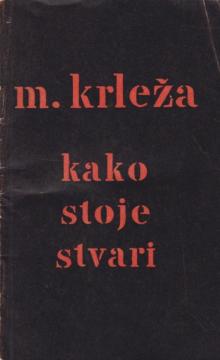
Kako stoje stvari: Predavanje održano u Domu JNA u Zagrebu 17. 12. 1952.
Ein rares Buch

Kako stoje stvari: Predavanje održano u Domu JNA u Zagrebu 17. 12. 1952.

Miroslav Krleža

In his lecture How Things Are (1952), Krleža discusses the political and cultural situation of post-war Yugoslavia, emphasizing the need for critical thought, cultural renewal, and resistance to dogmatism.

“How Things Are” is a transcript of Krleža’s lecture given on December 17, 1952, at the Yugoslav People’s Army House – a speech set in a period of intense political and cultural turmoil following the breakup with the Informbiro. Krleža addresses the audience as a writer, intellectual, and participant in the times, with the intention of explaining what cultural and political work means in a country that is just trying to rebuild itself from the ruins of war and ideological fractures.

Krleža analyzes the state of society without pathos: he speaks of the necessity to break with dogmas, empty phrases, and bureaucratic automatisms that stifle the creative spirit. He emphasizes the importance of education, critical awareness, and cultural openness, contrasting them with the mentality of the “ideological shelf” and the routine that turns the revolution into a mere administrative mechanism. His rhetoric is forceful, but not propagandistic; he insists on the responsibility of intellectuals and the need for society to develop a culture of dialogue, not blind compliance.

The text, like most of Krleža's public speeches, is full of historical references, irony and broad cultural observations. The speech does not hide the tensions of the times: Krleža speaks about the dangers of introversion, the consequences of fanaticism and the meaning of "new delusions" that can appear where thought turns into dogma. At the same time, the text also carries a strong optimistic element - the belief that it is possible to build a society based on knowledge, creativity and freedom of ideas.

As things stand, therefore, it remains an important document of the times and a unique combination of political speech and essay: Krleža's view of the state of society from the perspective of a writer who does not accept simple truths and who believes that culture is the foundation of all true renewal.

Titelseite
Mato Benković
Maße
18,5 x 11,5 cm
Seitenzahl
41
Verlag
Zora, Zagreb, 1953.
 
Latein Schrift. Taschenbuch.
Sprache: Kroatisch.

Angeboten wird ein Exemplar

Zustand:Gebraucht, in ausgezeichnetem Zustand
Zum Warenkorb hinzugefügt!
 

Interessieren Sie sich für ein anderes Buch? Sie können das Angebot über unsere Suchmaschine suchen und finden oder Bücher nach Kategorien durchsuchen.

Diese Titel könnten Sie auch interessieren

Izabrane pjesme

Izabrane pjesme

Miroslav Krleža

Ovaj izbor Krležinih pjesma presjek je njegove cjelokupne poezije (osim Simfonija i Balada Petrice Kermpuha), uključujući i stihove koji čine sastavni dio širih proznih cjelina čime se pokušala naglasiti povezanost Krležine poezije i proze.

Matica hrvatska, 1963.
Kroatisch. Latein Schrift. Fester Einband mit Schutzumschlag.
9,997,99
Povratak Filipa Latinovicza

Povratak Filipa Latinovicza

Miroslav Krleža

Povratak Filipa Latinovića jedan je od najpoznatijih romana Miroslava Krleže. Ovaj roman je značajan u našoj književnosti jer se smatra prvim potpuno modernim hrvatskim romanom.

Večernji list, 2004.
Kroatisch. Latein Schrift. Fester Einband mit Schutzumschlag.
5,52 - 5,56
Hrvatski bog Mars

Hrvatski bog Mars

Miroslav Krleža

Hrvatski bog Mars donosi sedam antiratnih romana u kojima Krleža prikazuje rat kao surovu, besmislenu mašineriju koja uništava „malog čoveka“, razotkrivajući licemerje militarizma i mitove o herojstvu.

Rad, 1965.
Serbisch. Latein Schrift. Taschenbuch.
1,99
Klima izdaje

Klima izdaje

Andrew Boyle

Eine detaillierte Studie über die berüchtigten Cambridge-Spione, eine Gruppe britischer Intellektueller, die im 20. Jahrhundert für die Sowjetunion spionierten. Das Buch ist im dokumentarischen Stil geschrieben, erzählt aber mit einer spannenden Erzählung

August Cesarec, 1982.
Kroatisch. Latein Schrift. Fester Einband mit Schutzumschlag.
6,24
Urotnička pisma Marina Držića - s faksimilima pisama

Urotnička pisma Marina Držića - s faksimilima pisama

Marin Držić

Die konspirativen Briefe von Marin Držić stellen ein äußerst wichtiges Dokument in der kroatischen politischen und literarischen Geschichte des 16. Jahrhunderts dar. Mit einem Nachdruck des Originalmanuskripts der Verschwörungsbriefe und des „Wechsels“ vo

Sveučilišna naklada Liber (SNL), 1989.
Kroatisch. Latein Schrift. Taschenbuch.
21,46
Sjaj Danice ilirske, ili preko 630 citata o raznim krijepostima i dužnostima

Sjaj Danice ilirske, ili preko 630 citata o raznim krijepostima i dužnostima

Eine Anthologie zum 20. Geburtstag von Danica Illyrska mit über 630 Gedichten und Zitaten zu Tugenden und Pflichten. Der illyrische Geist, verwandelt in einen praktischen moralischen und patriotischen Kompass für die Bildung von Herz, Verstand und Gemeins

Nakladom antikvarne knjižare M. F. Strmeckoga, 1888.
Kroatisch. Latein Schrift. Taschenbuch.
8,46