Historija Gestapoa

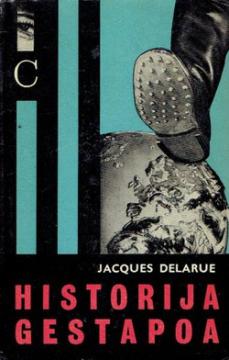
Historija Gestapoa

Jacques Delarue

"Gestapo", those three syllables made Germany tremble for twelve years, and then all of Europe. They remain a universal symbol of oppression and terror.

Soon the last witnesses of this infernal organization will disappear, and the new generations must know how all this was possible, how the totalitarian system functions from the inside, the peak of which was Nazism. Never, in any country or in any period, has a police system reached such complexity and achieved such a degree of "perfection" in efficiency and terror. From 1933 to 1945, the administrative methods and relentless action of the Gestapo allowed the Nazi regime to impose a rule of force and arbitrariness. This book "dismantles" the mechanism of this steel frame, run by ordinary people who have become monsters in the eyes of humanity.

Original title
Histoire de la Gestapo
Translation
Marija Eker-Manolić
Editor
Josip Barković
Graphics design
Andre Lušičić
Dimensions
20 x 13 cm
Pages
509
Publisher
Epoha, Zagreb, 1966.
 
Latin alphabet. Hardcover with dust jacket.
Language: Croatian.

No copies available

The last copy was sold recently.
 

Are you interested in another book? You can search the offer using our search engine or browse books by category.

You may also be interested in these titles

Hrvatsko domobranstvo u Drugom svjetskom ratu

Hrvatsko domobranstvo u Drugom svjetskom ratu

Ivan Košutić

The book provides a detailed account of the development, organization, and operations of the Croatian Home Guard, the regular army of the Independent State of Croatia (NDH), in the period from 1941 to 1945.

Nakladni zavod Matice hrvatske, 1992.
Croatian. Latin alphabet. Hardcover with dust jacket.
11.56
Zaraćeno poraće: Konfliktni i konkurentski narativi o stradanju i iseljavanju Talijana Istre

Zaraćeno poraće: Konfliktni i konkurentski narativi o stradanju i iseljavanju Talijana Istre

Franko Dota

The book analyzes how conflicting historical narratives about the suffering and mass emigration of Italians from Istria and Rijeka developed in Croatia and Italy after World War II (1943–1956), debunking myths and encouraging an empathetic approach to the

Srednja Europa, 2010.
Croatian. Latin alphabet. Paperback.
11.32
Doživljaji i putovanja do slobode

Doživljaji i putovanja do slobode

Vladimir Novak

The autobiographical work of Croatian communist activist Vladimir Novak, a survivor of the Ustasha camps, follows his memories of resistance to fascism during World War II.

August Cesarec, 1979.
Croatian. Latin alphabet. Hardcover with dust jacket.
8.26
Frizirani Pearl Harbor

Frizirani Pearl Harbor

Frank A. Schuler Jr., Robin Moore

The authors investigate the controversial thesis that the US government knew about the Japanese attack on Pearl Harbor before December 7, 1941. They analyze documents, testimonies, and intelligence failures that indicate a possible cover-up.

NIŠRO "Vjesnik", 1977.
Croatian. Latin alphabet. Hardcover.
6.324.42
Hrvatska u arhivima izbjegličke vlade 1941-1943.: Izvještaji informatora o prilikama u Hrvatskoj

Hrvatska u arhivima izbjegličke vlade 1941-1943.: Izvještaji informatora o prilikama u Hrvatskoj

Ljubo Boban

Academician Ljubo Boban, in his work Croatia in the Archives of the Government in Exile 1941–1943, brings together a collection of diplomatic reports from various European and international representative offices of the Yugoslav government in exile during

Globus, 1985.
Croatian. Latin alphabet. Hardcover with dust jacket.
9.52
Nevidljivi neprijatelj na Atlantiku 1-2

Nevidljivi neprijatelj na Atlantiku 1-2

Boris Prikril

The book provides a detailed account of naval conflicts in the Atlantic Ocean during World War II, with particular emphasis on the Battle of the Atlantic Convoy and the activities of German submarines – the so-called "invisible enemy".

Znanje, 1985.
Croatian. Latin alphabet. Hardcover with dust jacket.
The book consists of two volumes
6.984.89