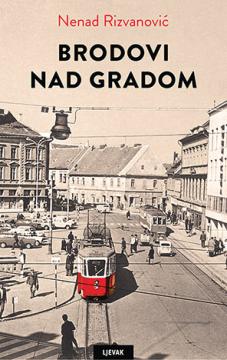
Brodovi nad gradom

Brodovi nad gradom

Nenad Rizvanović

Nenad Rizvanović is a writer of memories and a writer of Osijek, the city of his childhood and youth, who documents the only way in which literature is truly created - its people.

Brodovi nad gradom is a book of Osijek's very intimate topography, from Turkish history, through the nineteenth-century spatial (lack of) self-awareness of Osijek to Osijek's "socialist renaissance", a story about a city that gives the friendly eye of the storyteller little secret insights into spaces, buildings, mysterious street networks, into historical sediments that are reflected in the changes in the names of streets and squares, in Pannonian mildness and stubbornness. Osijek, Yugoslavia, is the narrator's childhood heterotopia recreated in the story of his own surreal urban genetic code.

At the beginning of Nenad Rizvanović's book Ships over the City, a motto from Walter Benjamin's childhood in Berlin is stated about wandering through the city as a sensory skill in which detail and emotion merge, about the city as a metaphorical forest through which we wander in a sweet haze of deliberate disorientation. Adopting this motto almost literally, Rizvanović's Osijek in the book becomes a historical symbolic forest through which the unnamed narrator wanders, mapping in his mind the networks of Osijek's alternative city history and gossip, finding paradoxical coincidences between the historical memory of the city and his own upbringing in the same city.

Editor
Dubravka Zima
Illustrations
Krešimir Lendić, Stjepan Kes, Željko Stojanović
Graphics design
Ana Pojatina
Dimensions
21 x 14 cm
Pages
184
Publisher
Naklada Ljevak, Zagreb, 2023.
 
Latin alphabet. Hardcover with dust jacket.
Language: Croatian.
ISBN
978-9-53355-696-3

No copies available

The last copy was sold recently.
 

Are you interested in another book? You can search the offer using our search engine or browse books by category.

You may also be interested in these titles

Pretapanja: Pannonius-Vrančić

Pretapanja: Pannonius-Vrančić

Helena Sablić Tomić

The book explores how different cultures and traditions intertwine and influence each other throughout history. Also, the book touches on the topics of identity, migration and transformation of societies.

Oksimoron, 2010.
Croatian. Latin alphabet. Hardcover.
14.6211.70
Kad ste utopljeni u plamenu

Kad ste utopljeni u plamenu

David Sedaris

Ako vam se čini da se ispod površine ponekad monotone svakodnevice krije urnebesan apsurd, Dejvid Sedaris će vas konačno u to ubediti.

Algoritam, 2010.
Croatian. Latin alphabet. Paperback.
3.98
Dnevnik 2: Dnevnik 1918-22 (Davni dani II)

Dnevnik 2: Dnevnik 1918-22 (Davni dani II)

Miroslav Krleža
NIŠRO Oslobođenje, 1981.
Croatian. Latin alphabet. Paperback.
6.78
Sizifova sreća - razgovori, kronike

Sizifova sreća - razgovori, kronike

Ivan Lovrenović

Zbirka Ivana Lovrenovića dokumentuje trideset godina promena u Bosni i Hercegovini kroz intervjue, eseje i dijaloge. Autor, svedok epohe, ispituje stare stavove u novoj stvarnosti, naglašavajući atrofiju racionalnosti i društvenog značenja.

Synopsis, 2018.
Croatian. Latin alphabet. Paperback.
12.5410.03
Pismo nerođenom djetetu

Pismo nerođenom djetetu

Oriana Fallaci

One of the most moving and courageous works of world literature of the 20th century. Written as a long monologue by a pregnant woman (Fallaci herself), the book is at once an intimate confession, a feminist manifesto, and a philosophical confrontation wit

Znanje, 2009.
Croatian. Latin alphabet. Paperback.
4.56
Život Betovenov

Život Betovenov

Romain Rolland

The translation of this book was originally published in 1923 by the Belgrade bookseller S. B. Cvijanović, but the entire edition was confiscated and destroyed by the Germans during the Second World War.

Matica srpska, 1947.
Croatian. Latin alphabet. Paperback.
5.24