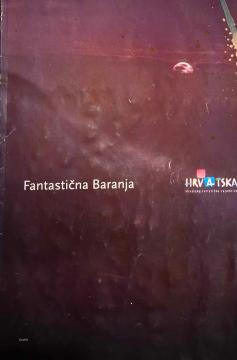
Fantastična Baranja

Fantastična Baranja

Dario Topić

Baranja is a region located in northeastern Croatia and southeastern Hungary, between the Drava and Danube rivers.

Baranja has a rich history that dates back to prehistoric times, with archaeological findings indicating the presence of cultures such as the Vučedol culture. Throughout history, the area has been influenced by the Roman Empire, the Ottoman Empire, the Habsburg Monarchy, and other rulers.

Today, Baranja is known for its multiculturalism, with Croats, Hungarians, Serbs, and other ethnic groups living there. Preserved folk traditions, specific village architecture, tamburitza music, and a rich gastronomic offer make it a special part of Croatia.

Editor
Slavija Jačan Obratov
Illustrations
Mario Romulić, Dražen Stojčić, Bojan Sivački
Graphics design
Bojan Sivački
Dimensions
29.5 x 20 cm
Pages
87
Publisher
Hrvatska turistička zajednica, Zagreb, 2010.
 
Latin alphabet. Paperback.
Language: Croatian.

One copy is available

Condition:Used, very good condition
Damages or inconvenience notice:
  • Slight damage to the cover
 

Are you interested in another book? You can search the offer using our search engine or browse books by category.

You may also be interested in these titles

Američki medijski blues

Američki medijski blues

Dario Topić

What exactly is television? How does it function in a promised land that uses it to produce its own history, and at a rapid pace, in the absence of a tradition of the European or any other ancient type?

Matica hrvatska, 1996.
Croatian. Latin alphabet. Paperback.
4.86
Đakovo

Đakovo

Zdravka Dean, Ive Mažuran

​The monograph by Zdravka Dean and Ivo Mažuran provides a comprehensive overview of the history, culture and life of Đakovo. The monograph is a valuable read for anyone who wants to learn more about Đakovo, its history, cultural heritage and contemporary

Dean, 2003.
Croatian. Latin alphabet. Hardcover.
11.56
Tri stoljeća Belja

Tri stoljeća Belja

Belje is the oldest business entity in Croatia, which has been operating continuously for more than 300 years. The origin and development of the economy of Belje are conditioned by historical and war events in this part of Europe.

Jazu, 1986.
Croatian. Latin alphabet. Hardcover with dust jacket.
56.22
Slavonci i preljubnici

Slavonci i preljubnici

Ante Duić

Journalist and publicist Ante Duić, in his free time, visited Slavonian villages and wrote down what he considered important to record and preserve from oblivion.

Privlačica, 1985.
Croatian. Latin alphabet. Paperback.
5.98
Listovi iz Slavonije

Listovi iz Slavonije

Isidor Kršnjavi

The role of Slavonia in Croatian literature and culture

Privlačica, 1992.
Croatian. Latin alphabet. Paperback.
4.52
Proizvodnja pokljuka u Požeškom Novom Selu: Separat

Proizvodnja pokljuka u Požeškom Novom Selu: Separat

Zdenka Lechner

Zdenka Lechner, the first ethnologist at the Museum of Slavonia (1951–1965), made significant contributions to the study of the traditional culture of Slavonia, including the use of pokljuc – earthen lids for baking bread and pastries on the hearth.

Muzej Slavonije, 1962.
Croatian. Latin alphabet. Paperback.
6.32