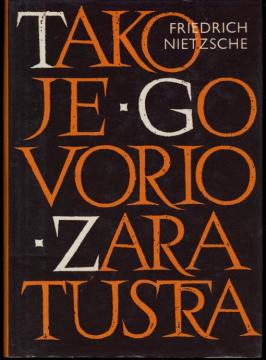
Tako je govorio Zaratustra
Rare book

Tako je govorio Zaratustra
Friedrich Nietzsche

A philosophical novel that presents the key ideas of Nietzsche's philosophy through a poetic and allegorical style. Zarathustra, a character inspired by an ancient Persian prophet, descends from a mountain after ten years of solitude to share his wisdom w

Divided into four parts, Zarathustra preaches concepts such as the Übermensch, symbolizing man creating his own values and overcoming nihilism after the "death of God" - the idea that traditional religious and moral systems have lost their authority. He criticizes Christianity and conventional morality as restrictive forces, advocating individualism, self-realization, and the acceptance of life in its fullness, including suffering.

The concept of eternal recurrence - the idea that life repeats itself endlessly - challenges man to live authentically, as if each moment would last forever. Zarathustra is confronted by a variety of characters, such as priests, skeptics, and ordinary people, who often reject his ideas, reflecting Nietzsche's critique of the masses and conformity.

Through parables, speeches, and metaphors, the work explores themes of freedom, the will to power, and the search for meaning in a world without absolute truths. Zarathustra ultimately remains alone but determined in his mission. The novel is layered, provocative and deeply philosophical, inviting the reader to introspect and reevaluate their own beliefs.

Original title
Also sprach Zarathustra
Translation
Danko Grlić
Dimensions
20 x 14 cm
Pages
358
Publisher
Mladost, Zagreb, 1983.
 
Latin alphabet. Hardcover with dust jacket.
Language: Croatian.

No copies available

The last copy was sold recently.
 

Are you interested in another book? You can search the offer using our search engine or browse books by category.

You may also be interested in these titles

Knjiga o filozofu

Knjiga o filozofu

Friedrich Nietzsche
Grafos, 1987.
Serbian. Latin alphabet. Paperback.
9.99
Hura, još živimo

Hura, još živimo

Johannes M. Simmel

The novel follows the life of Jakob Formann from 1946 to 1976: from a poor returnee from the war, through business ups and downs, love, marriages and scandals, to becoming one of the richest and most famous people in Germany.

Mladost, 1980.
Croatian. Latin alphabet. Hardcover with dust jacket.
6.48
Kaiserove kulije: roman njemačke ratne mornarice

Kaiserove kulije: roman njemačke ratne mornarice

Theodor Plievier

The Kaiser's Coolies (1930) is an anti-militarist novel by Theodor Plievier. Based on his own experience, it depicts the brutal life of ordinary sailors in the German navy during World War I and the sailors' mutiny of 1917.

Naklada Binoza, 1934.
Croatian. Latin alphabet. Hardcover with dust jacket.
5.26
I ne reče ni reči

I ne reče ni reči

Heinrich Böll

In Boll's novels, one of the central themes is the attempt to preserve basic moral values ​​in a time of terror, as well as in a period of material prosperity and corruption.

Svjetlost, 1965.
Serbian. Latin alphabet. Paperback.
3.22 - 3.98
Kako vojnik popravlja gramofon

Kako vojnik popravlja gramofon

Saša Stanišić

Aleksandar is the most skilled fisherman, the greatest magician and a passionate football player. He knows the first chapter of Marx's Capital by heart, and he enjoys telling stories the most.

Fraktura, 2013.
Croatian. Latin alphabet. Hardcover with dust jacket.
10.98
Proces

Proces

Franz Kafka

Kafka wrote The Process between 1914 and 1915, published posthumously in 1925. The novel is unfinished but with an added final chapter by Max Brod. Edition with a foreword by B. Živojinović and an afterword by Walter Killi.

BIGZ, 1990.
Serbian. Latin alphabet. Paperback.
4.26