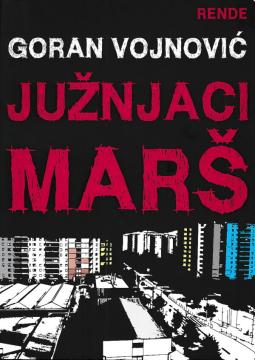
Južnjaci marš

Južnjaci marš

Fužine is a settlement in Ljubljana, very similar to the blocks in New Belgrade, built during the socialist era for workers from the south of the SFRY who still do not have minority rights.

In the meantime, this neighborhood has become a ghetto ruled by criminals, turbo-folk music and jibbers. "Fuzine is like an Olympic village, because everyone wears tracksuits and speaks a different language. No one fucks anyone even five percent." The main character of the novel, Marko Đorđić, the seventeen-year-old son of Bosnian Serb emigrants and a talented basketball player with an identity crisis, one evening makes a rash decision to leave basketball to try to be what he wants, not what he is. "Maybe I'm not talented at your Slovenian, but maybe I'm talented at something else, you just haven't bothered to find out what it is. Every man is certainly talented at something." But a man's origin is sometimes stronger than himself, so Marko survives a series of unpleasant events (drunkenness, demolishing a bus, arrest, etc.), and on the orders of his father, he goes to Bosnia, the homeland of his ancestors, for "re-education"... The Slovenian police tried to "discipline" the writer Goran Vojinović and sued him for defamation due to the bad representation of policemen in the novel (which, among other things, Vojnović derogatorily calls cops, gendarmes, guards, dustmen)! After pressure from the public, art organizations and the Slovenian Minister of the Interior, the police withdrew the criminal prosecution.

Original title
Čefurji raus
Translation
Ana Ristović
Editor
Slađana Novaković
Illustrations
Barbara Culiberg
Graphics design
Branko Đukanović
Dimensions
20 x 14.5 cm
Pages
196
Publisher
Rende, Beograd, 2008.
 
Distribution: 500 copies
 
Latin alphabet. Paperback.
Language: Serbian.

One copy is available

Condition:Used, excellent condition
Discounted price: 8.326.24
25% discount is valid until 4/11/26 11:59 pm
 

Are you interested in another book? You can search the offer using our search engine or browse books by category.

You may also be interested in these titles

Proces

Proces

Franz Kafka

Kafka wrote The Process between 1914 and 1915, published posthumously in 1925. The novel is unfinished but with an added final chapter by Max Brod. Edition with a foreword by B. Živojinović and an afterword by Walter Killi.

BIGZ, 1990.
Serbian. Latin alphabet. Paperback.
4.26
Pripovetke iz levog i desnog džepa

Pripovetke iz levog i desnog džepa

Karel Čapek

These stories deal with different topics, although most deal with different criminal acts, from fraud and fortune-telling to marriage fraud and murder.

Jugoslavijapublik, 1980.
Croatian. Latin alphabet. Hardcover.
5.22
Neprijatelji / ljubavna priča

Neprijatelji / ljubavna priča

Isaac Bashevis Singer

Enemies: A Love Story, perhaps Singer's best-known novel, takes place in New York in the 1950s.

Svjetlost, 1986.
Croatian. Latin alphabet. Hardcover with dust jacket.
5.98
Aurorin poticaj

Aurorin poticaj

Erich Hackl

The work is based on a true event that occurred in Spain in 1933: Aurora Rodriguez killed her daughter Hildegart, a famous fighter for women's emancipation and a cult figure on the political scene of the time.

Mladost, 1990.
Croatian. Latin alphabet. Hardcover with dust jacket.
4.98
Eva Luna

Eva Luna

Isabel Allende

Eva Luna is a novel about a poor storyteller who weaves lives with words, written by Isabel Allende, the founder of Latin American magical realism. Published after the success of The House of the Spirits, this whirlwind of adventure combines love, revolut

Znanje, 1990.
Croatian. Latin alphabet. Hardcover with dust jacket.
8.36
Usta puna zemlje

Usta puna zemlje

Branimir Šćepanović

The novel "Usta puna zemlje" (1970), the masterpiece of the Serbian writer Branimir Šćepanović, is a psychologically in-depth explorer of the limits of the human soul, solitude and existential freedom, reminiscent of Kafka and Camus.

BIGZ, 1987.
Serbian. Latin alphabet. Paperback.
3.98