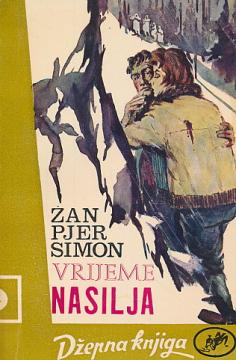
Vrijeme nasilja

Vrijeme nasilja

Jean-Pierre Simon

A Time of Violence (1966) is an anti-war and activist novel by French writer Jean-Pierre Simon, a lesser-known author from the mid-20th century, whose work bears traces of leftist literature of the 1930s and 1940s.

The story follows the life of the main character Jean, a Frenchman who joins the International Brigades in the Spanish Civil War in 1936. The novel is divided into two main periods: the first is his participation in the battles on the Republican side against the fascists, where he witnesses the brutality of the war, ideological conflicts, heroism and betrayals. The second part describes his life in captivity and a concentration camp after the Republican defeat, where he suffers hunger, torture, humiliation and the struggle for survival.

Simon realistically and without pathos depicts violence as an everyday reality of war and repression: physical violence, psychological crushing, loss of illusions and dehumanization. The novel is not only a war chronicle, but also a criticism of fascism, totalitarianism and the senseless violence, with an emphasis on solidarity among prisoners and a desperate struggle to preserve humanity.

The style is direct, documentary, with elements of autobiography or reportage (similar to Malraux or Hemingway in the Spanish theme). The work was popular in Yugoslavia in the 1960s, attracting readers interested in anti-fascist and anti-war prose. Today it is considered a rare example of French literature on the Spanish Civil War translated into our country, appreciated for its authentic portrayal of historical events and its universal message about the price of violence.

Original title
Terre de violence“
Translation
Srećko Džamonja
Editor
Risto Trifković
Graphics design
Mirko Stojnić
Dimensions
16.5 x 11 cm
Pages
195
Publisher
Svjetlost, Sarajevo, 1965.
 
Latin alphabet. Paperback.
Language: Croatian.

One copy is available

Condition:Unused
 

Are you interested in another book? You can search the offer using our search engine or browse books by category.

You may also be interested in these titles

Deobe

Deobe

Dobrica Ćosić

Deobe is a novel about the tragic division of Serbs into Chetniks and Partisans during World War II. Winner of the NIN Award, it is part of a wider epic trilogy, inspired by Ćosić's experiences and historical documents.

Prosveta, 1963.
Croatian. Latin alphabet. Hardcover with dust jacket.
13.74
08/15: u kasarni / 08/15: u ratu / 08/15: do kraja

08/15: u kasarni / 08/15: u ratu / 08/15: do kraja

Hans Hellmut Kirst

Hans Hellmut Kirst's trilogy 08/15 follows soldier Asch from his life in the barracks, through the front and the post-war period. Through irony and dark humor, he exposes the senselessness of war, the moral collapse of the Wehrmacht, and a society that pr

Grafički zavod Hrvatske (GZH), 1981.
Croatian. Latin alphabet. Hardcover with dust jacket.
The book consists of 3 volumes
32.56
Zaboravljene djevojke

Zaboravljene djevojke

Martha Hall Kelly

The novel The Forgotten Girl is based on the real life of a member of New York's posh circles, who fought for the rights of Kunić, a group of women who survived the horrors of the Ravensbrück concentration camp.

Mozaik knjiga, 2018.
Croatian. Latin alphabet. Paperback.
7.98
Ranjeni pejzaž

Ranjeni pejzaž

Vladimir Mičetić

A book by Vladimir Mičetić, a doctor and volunteer of the Homeland War from Kutina. The work was awarded the literary prize "We Were the First When It Was Necessary" for 2010, awarded by the Association of Croatian Homeland War Veterans.

Spiritus Movens, 2010.
Croatian. Latin alphabet. Hardcover.
11.52
Mila 18

Mila 18

Leon Uris

Mila 18 is a novel about the legendary uprising in the Warsaw ghetto. To write the novel, Uris spent years studying archival materials, visiting the places where the events took place and talking to survivors of the ghetto...

Matica hrvatska, 1970.
Croatian. Latin alphabet. Hardcover with dust jacket.
7.24