Nemirni mir
Antique
Rare book

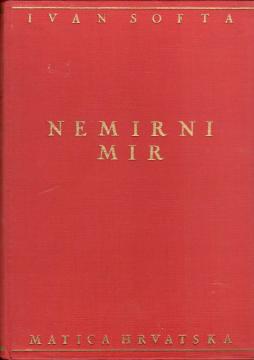
Nemirni mir

Ivan Softa

Uneasy Peace (1940) depicts the life of Herzegovinian peasants after World War I, their emigration to Slavonia, the difficult struggle for survival and inner unrest in the apparent peace of the post-war period.

The work is thematically closely related to his previous novel Days of Misery and Hunger (1937) and represents a continuation of the story about the fate of a Herzegovinian peasant in a turbulent period. The plot takes place after the end of World War I. Softa follows the characters who survived the horrors of war and famine, and now seek a better life in Slavonia.

The novel is realistic, in places naturalistic, depicting their new troubles – hard work on someone else's land, social disarray, family dramas, alcoholism and deep inner unrest. Despite the external "peace", the characters carry the traumas of war, poverty and disappointment, which creates an atmosphere of constant tension and existential anxiety.

Critics have pointed out that Uneasy Peace shows the maturation of Softa's talent – ​​the novel is psychologically deeper than the previous one, with a stronger modern overtone and closeness to Hamsun's imagination of hunger and inner evil. Softa is no longer just a painter of the Herzegovinian village, but also a modern storyteller who explores the human psyche in difficult social circumstances.

The style is sharp, direct and unadorned, with a strong Herzegovinian dialect and an authentic depiction of the Dinaric mentality – tough, proud, but also vulnerable. The novel exudes pessimism and a sense of meaninglessness, typical of socially engaged prose of the late 1930s.

Uneasy Peace is considered one of Softa's best works and an important example of Croatian social-realist prose of the interwar period. Due to the author's death on the Way of the Cross in 1945, his work was neglected after the war. Today, the novel is valued as a powerful testimony to the fate of Herzegovina and the difficult post-war years.

The Matica Hrvatska edition is rare.

Dimensions
20 x 14 cm
Pages
132
Publisher
Matica hrvatska, Zagreb, 1940.
 
Latin alphabet. Hardcover.
Language: Croatian.

Multiple copies are available

Copy number 1

Condition:Unused

Copy number 2

Condition:Used, excellent condition

Copy number 3

Condition:Used, good condition (visible signs of use)
Damages or inconvenience notice:
  • Traces of patina
  • Worn covers
 

Are you interested in another book? You can search the offer using our search engine or browse books by category.

You may also be interested in these titles

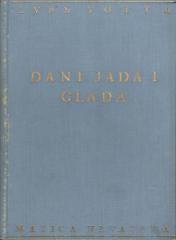
Dani jada i glada

Dani jada i glada

Ivan Softa

A novel by Ivan Softa about life in a Herzegovinian village during World War I. It realistically and poignantly depicts misery, hunger, disease, war mobilization, and the suffering of peasants, condemning war and social injustices.

Matica hrvatska, 1937.
Croatian. Latin alphabet. Hardcover.
9.72 - 11.34
Grička vještica IV: Suparnica Marije Terezije 1

Grička vještica IV: Suparnica Marije Terezije 1

Marija Jurić Zagorka

The first part of Maria Theresa's Rivals moves the series' plot to the Viennese court, where the conflict between the empress and her rival sets off a web of political intrigue, love, and betrayal.

Jutarnji list, 2012.
Croatian. Latin alphabet. Paperback.
5.24
Ljudi i majmuni

Ljudi i majmuni

Fadil Hadžić

People and Monkeys is a collection of satires, humoresques, fables, and aphorisms in which Fadil Hadžić, through humor and irony, exposes human vanity, hypocrisy, greed, and the abuse of social power.

Stvarnost, 1975.
Croatian. Latin alphabet. Hardcover with dust jacket.
13.5610.17
Moskovski dnevnik

Moskovski dnevnik

Saša Vereš

Saša Vereš's Moscow Diary is a blend of travelogue, diary, and cultural-essay prose, a book about Moscow, Russian literature, and the encounter of personal impressions with a great cultural tradition.

Zora, 1966.
Croatian. Latin alphabet. Hardcover with dust jacket.
4.32
Sretni Martin / Martin im Glück

Sretni Martin / Martin im Glück

Tomo Živko

Martin's life story depicts the fate of the Danube Swabians in Slavonia. Through personal family memories, life's trials and historical changes, the novel bears witness to identity, homeland and the strength of man.

Njemačka narodnosna zajednica, 2008.
Croatian. Latin alphabet. Paperback.
8.32
Smrt Petera Esterházyja: šest priča o smrti

Smrt Petera Esterházyja: šest priča o smrti

Mirko Ćurić

In the collection The Death of Peter Esterhazy - Six Stories about Death, Mirko Ćurić, through six prose pieces, connects the theme of dying with human transience, memory, and the attempt to find meaning in the end of life.

Đakovački kulturni krug, 2016.
Croatian. Latin alphabet. Hardcover.
7.64