Nemirni mir
Antikvitet
Retka knjiga

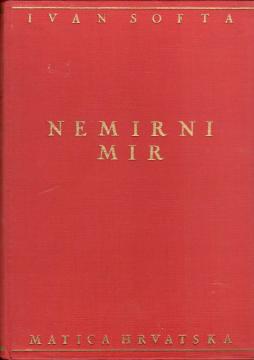
Nemirni mir

Ivan Softa

Uneasy Peace (1940) depicts the life of Herzegovinian peasants after World War I, their emigration to Slavonia, the difficult struggle for survival and inner unrest in the apparent peace of the post-war period.

The work is thematically closely related to his previous novel Days of Misery and Hunger (1937) and represents a continuation of the story about the fate of a Herzegovinian peasant in a turbulent period. The plot takes place after the end of World War I. Softa follows the characters who survived the horrors of war and famine, and now seek a better life in Slavonia.

The novel is realistic, in places naturalistic, depicting their new troubles – hard work on someone else's land, social disarray, family dramas, alcoholism and deep inner unrest. Despite the external "peace", the characters carry the traumas of war, poverty and disappointment, which creates an atmosphere of constant tension and existential anxiety.

Critics have pointed out that Uneasy Peace shows the maturation of Softa's talent – ​​the novel is psychologically deeper than the previous one, with a stronger modern overtone and closeness to Hamsun's imagination of hunger and inner evil. Softa is no longer just a painter of the Herzegovinian village, but also a modern storyteller who explores the human psyche in difficult social circumstances.

The style is sharp, direct and unadorned, with a strong Herzegovinian dialect and an authentic depiction of the Dinaric mentality – tough, proud, but also vulnerable. The novel exudes pessimism and a sense of meaninglessness, typical of socially engaged prose of the late 1930s.

Uneasy Peace is considered one of Softa's best works and an important example of Croatian social-realist prose of the interwar period. Due to the author's death on the Way of the Cross in 1945, his work was neglected after the war. Today, the novel is valued as a powerful testimony to the fate of Herzegovina and the difficult post-war years.

The Matica Hrvatska edition is rare.

Dimenzije
20 x 14 cm
Broj strana
132
Izdavač
Matica hrvatska, Zagreb, 1940.
 
Latinica. Tvrde korice.
Jezik: Hrvatski.

Više primeraka je u ponudi

Primerak broj 1

Stanje:Nekorišćeno
Dodato u korpu!

Primerak broj 2

Stanje:Korišćeno, u odličnom stanju
Dodato u korpu!

Primerak broj 3

Stanje:Korišćeno, u dobrom stanju (tragovi korišćenja)
Oštećenja / nepogodnosti:
  • Traces of patina
  • Worn covers
Dodato u korpu!
 

Zanima Vas i neka druga knjiga? Možete pretražiti našu ponudu pomoću pretrage ili prelistati knjige po kategorijama.

Možda će Vas zanimati i ovi naslovi

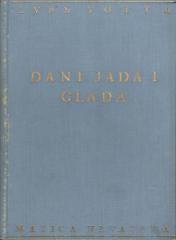
Dani jada i glada

Dani jada i glada

Ivan Softa

A novel by Ivan Softa about life in a Herzegovinian village during World War I. It realistically and poignantly depicts misery, hunger, disease, war mobilization, and the suffering of peasants, condemning war and social injustices.

Matica hrvatska, 1937.
Hrvatski. Latinica. Tvrde korice.
9,72 - 11,34
Lucia, Lucia

Lucia, Lucia

Adriana Trigiani

Lucia Sartori was the most beautiful girl in Greenwich Village in her youth. The youngest child and only daughter of a traditional Italian family, Lucia breaks off her engagement to the son of a local baker, because his mother expects Lucia to stop workin

Mozaik knjiga, 2004.
Hrvatski. Latinica. Broširano.
6,34
Malena je ime tanga

Malena je ime tanga

Almudena Grandes

If you like raw eroticism like Cloud Atlas, this is a sensual saga – emotional, provocative, for those who want to feel the pulse of forbidden passion! Grandes probes whether love is a curse or a liberation?

Mozaik knjiga, 2000.
Hrvatski. Latinica. Tvrde korice.
8,54
Za novim putem: novele

Za novim putem: novele

August Cesarec

"Za novi putem" is a collection of novels by Augusto Cesarco, originally published in 1919. This work is characteristic of his early creative period, marked by modernist aspirations and social sensitivity.

Matica hrvatska, 1926.
Hrvatski. Latinica. Broširano.
7,62
Pripovijesti

Pripovijesti

Ivan Franko

Contents: Bricklayer, Good earnings, Forests and pastures, Gypsies, On the light, Lady's bread, Note about the writer

Zora, 1950.
Hrvatski. Latinica. Broširano.
2,96 - 2,98
Ravnodušni ljudi

Ravnodušni ljudi

Alberto Moravia

The novel follows the declining Roman bourgeois family of Ardengo over the course of several days: widow Mariagrazia, lover Leo, son Michele, and daughter Carla – all trapped in apathy, lies, sexual manipulation, and moral indifference.

Otokar Keršovani, 1966.
Hrvatski. Latinica. Tvrde korice.
3,22