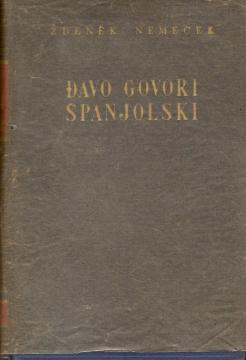
Đavo govori španjolski
The novel tells a moving story about the Spanish Civil War. Through the fates of journalists, intellectuals and ordinary people, it depicts the brutality, ideological conflicts and demonic side of a war in which "the devil speaks Spanish".
The novel is inspired by and partly based on the author's own impressions and experiences from the Spanish Civil War. Němeček portrays the war not as a heroic struggle, but as a demonic tragedy in which ideologies clash, and the ordinary man becomes the victim. Through the characters of journalists, intellectuals, soldiers and civilians, the novel shows the horrors of war, terror on both sides (Franco and Republican), propaganda, betrayal and the senselessness of violence.
The title The Devil Speaks Spanish is symbolic — it suggests that in Spain at that time, evil speaks the language of passion, love and poetry, which makes it even more dangerous and insidious. Němeček does not take an open side, but critically depicts fanaticism, false ideals and suffering that war brings to everyone. The style is dynamic, reporter-like and dramatic, with strong anti-war and humanist messages.
The book was banned in Prague in 1939 after Franco's intervention, which testifies to its sharpness. It was well received in Croatia and Yugoslavia in 1940, as the Spanish Civil War was a very current topic among intellectuals.
The work is one of the most significant European novels about the Spanish Civil War written from a neutral, humanistic perspective. Today it is a rare antiquarian and sought after among lovers of interwar literature, war prose, and Czech literature.
Dva primjerka su u ponudi
Primjerak broj 2
- Požutjeli listovi
- Mrlje na koricama