Čovjek
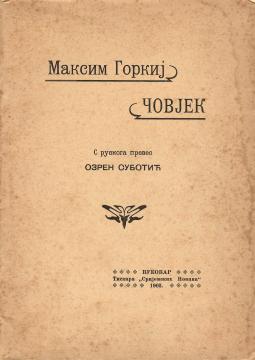
Man by Maxim Gorky, translated by Ozren Subotić (Vukovar, 1905), is a philosophical and literary work that glorifies the dignity of man, his creative power, freedom of spirit, and the fight against social injustice.
Man by Maxim Gorky is one of his most famous philosophical-poetic works from his earlier creative period. The book belongs to the period in which Gorky developed the idea of man as the central value of social and spiritual life, emphasizing his ability to create, morally elevate and resist all forms of humiliation.
The work is not a classic novel or short story, but a literary-philosophical text in which the author creates a kind of hymn to man. Gorky views man as a being who is constantly developing, exploring the world and striving to overcome the limits imposed by poverty, ignorance and social inequalities. At the heart of his thinking is the belief that man is the greatest force of nature because he possesses reason, creative energy and the ability to change his own destiny.
The text is permeated with humanistic and revolutionary ideas characteristic of Gorky's worldview. The author rejects passivity and submission and emphasizes the importance of work, knowledge, and collective struggle for a more just society. Man is portrayed as a bearer of progress, and his value does not stem from social position but from inner strength, dignity, and willingness to act for the common good.
Stylistically, the work is characterized by strong rhetorical expression, pathos, and symbolic images. Gorky uses a lofty tone, aphoristic thoughts, and poetic descriptions to emphasize the greatness of the human spirit. Such an approach connects literature, philosophy, and social thought, which is why Man is often viewed as a programmatic text of his humanistic worldview.
The Vukovar edition from 1905 testifies to the early reception of Gorky's works among South Slavic readers. The translation by Ozren Subotić* contributed to introducing the domestic audience to the ideas of Russian realism and socially engaged literature, which had a strong influence on cultural and intellectual life at the beginning of the 20th century.
One copy is available