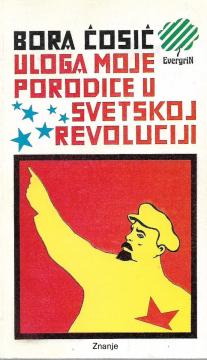
Uloga moje porodice u svetskoj revoluciji
Ein rares Buch

Uloga moje porodice u svetskoj revoluciji

Bora Ćosić

The boy Bora tells the story of a chaotic family in Belgrade during the war and the post-war revolution. Mom, dad, grandfather, uncle and aunts live an absurd everyday life full of laughter, chaos and irony, while the "world revolution" enters their apart

My Family's Role in the World Revolution by Bora Ćosić (1969) is a short novel, winner of the NIN award, and one of the most important works of Serbian (and Yugoslav) literature of the second half of the 20th century. It is written from the perspective of the boy Bora, which provides a naive, simple, almost diary-like narrative that masterfully reveals the absurdity of major historical events.

The plot follows the life of a large, dysfunctional Belgrade family during World War II and immediately after it, during the establishment of socialism. The main characters are: a paranoid and disorganized Mom, an alcoholic Dad who cannot hold down a job, a grandfather who doubts everything, an uncle (a transvestite), two aunts obsessed with Hollywood stars, and the narrator – the boy Bora. The family lives in constant chaos: they constantly talk, argue, recite, draw, eat, cry, and dream. War and occupation are almost secondary to them – family rituals and trifles are more important.

Ćosić ingeniously uses humor and absurdity to criticize and demystify great historical events. The revolution enters the house through the partisans and the new authorities who occupy the apartment, preach equality, but bring new bureaucracy, injustice and hypocrisy. The sentences are short, naive, like children's, but polished to perfection – each one carries a multi-layered meaning. The laughter is liberating, subversive and bitter; in the end the boy realizes that everything was that way or even worse.

The book is an autobiographical family epic, but also a sharp satire on the communist revolution, myths about the partisans and the new social order. It shows how ideology enters everyday life, changes relationships and turns ordinary people into players in a grand play. The style is innovative, modern, full of irony, an inventory of objects, language and the madness of the era.

The novel was dramatized twice in Atelje 212, and a film Bate Čengić (1971) was made based on it, which was soon banned. Today it is considered a must-read for understanding the Yugoslav 20th century – witty, painful and deeply humane. It can be read on any page and always brings a smile and recognition.

Editor
Zlatko Crnković
Illustrationen
Dušan Otašević
Titelseite
Alfred Pal
Maße
19,5 x 12,5 cm
Seitenzahl
128
Verlag
Znanje, Zagreb, 1987.
 
Latein Schrift. Taschenbuch.
Sprache: Serbisch.

Angeboten wird ein Exemplar

Zustand:Ungebraucht
Zum Warenkorb hinzugefügt!
 

Interessieren Sie sich für ein anderes Buch? Sie können das Angebot über unsere Suchmaschine suchen und finden oder Bücher nach Kategorien durchsuchen.

Diese Titel könnten Sie auch interessieren

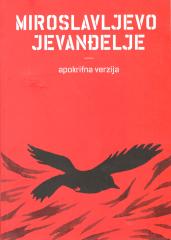
Miroslavljevo jevanđelje – apokrifna verzija

Miroslavljevo jevanđelje – apokrifna verzija

Bora Ćosić

Urnebesan strip za koji je scenario napisao Bora Ćosić, a crtala su ga četiri strip autora iz Hrvatske i Srbije - Igor Hofbauer, Damir Štajnfl, Boris Stanić i Vostok, dok je urednik Saša Rakezić (Aleksandar Zograf), zajedno sa Oliverom Stošić Rakić.

Kulturni centar Beograda, 2012.
Serbisch. Latein Schrift. Taschenbuch.
12,56
Pile na ražnju

Pile na ražnju

Jiří Šotola

Kvaziistorijski roman Jiržija Šotole „Gomila na ražnju“ prikazuje apsurdnost života kroz priču o antiheroju – lutkaru Matiji Pileu (Matej Kuže), lutkaru istorije tokom Napoleonovih ratova. Roman kritikuje totalitarizam kroz baroknu ironiju i postmodernu d

August Cesarec, 1983.
Kroatisch. Latein Schrift. Fester Einband mit Schutzumschlag.
4,82 - 4,84
Nevini lopovi: satire

Nevini lopovi: satire

Fadil Hadžić

Satirične priče Fadila Hadžića, jednog od najizvođenijih dramskih pisaca u našoj zemlji, obuhvataju širok spektar savremenih društvenih, ideoloških, kulturnih i psiholoških posebnosti.

Globus, 1988.
Kroatisch. Latein Schrift. Fester Einband mit Schutzumschlag.
8,24
Veseli šalabahter

Veseli šalabahter

„Veseli šalabahter“ je duhovita, razigrana i veoma pristupačna zbirka koja kroz humor pokazuje kako se o običnim temama može pisati na potpuno neočekivan način.

Karitativni fond UPT, 2004.
Kroatisch. Latein Schrift. Taschenbuch.
2,98
Životinjska farma

Životinjska farma

George Orwell

„Životinjska farma“ je kratki satirični distopijski roman britanskog pisca Džordža Orvela (Erik Artur Bler), jedno od najuticajnijih dela 20. veka. Orvel koristi jednostavan, bajkoviti stil da kritikuje totalitarizam i korupciju u vladi.

August Cesarec, 1985.
Kroatisch. Latein Schrift. Fester Einband mit Schutzumschlag.
9,76
Kvaka braka

Kvaka braka

Melanie Gideon

Melani Gideon, američka spisateljica poznata po svojim humorističkim romanima o porodičnoj dinamici, analizira monotoniju braka u doba društvenih medija u delu „Zamka braka“ (2012).

Algoritam, 2013.
Kroatisch. Latein Schrift. Taschenbuch.
7,36