Gospoda Golovljovi
Antique
Rare book

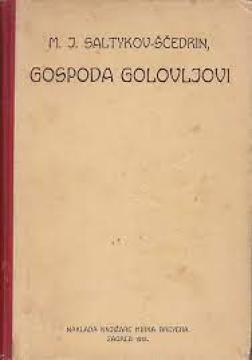
Gospoda Golovljovi

Mihail Evgrafovič Saltikov-Ščerdin

A rare and sought-after first Croatian edition of a classic of Russian literature. A masterpiece of satirical realism, it depicts the tragic story of the decline of the noble Golovlev family over several generations.

The novel is a profound and merciless critique of Russian society, especially the provincial nobility, false religiosity, hypocrisy, and greed. The author masterfully uses satire and irony to show the moral and material disintegration of a family whose members are trapped in a web of their own lies, greed, and mutual misunderstanding. The work is often considered the most powerful depiction of the “death of the soul” in Russian literature, where no one manages to escape the circle of hypocrisy and egoism.

The translation from the Russian by Isa Velikanović is considered a classic and very successful, and this Zagreb edition from 1918 represents an important part of the early translations of Russian classics into Croatian during the Austro-Hungarian Empire and World War I.

Today, this edition is a real rarity on the antiquarian market and is highly valued among collectors of Russian literature, lovers of realism, and literary historians. It represents not only a literary masterpiece, but also a valuable historical artifact of Croatian publishing from the beginning of the 20th century.

Original title
Gospoda Golovlevy
Translation
Iso Velikanović
Dimensions
21 x 14 cm
Pages
336
Publisher
Naklada knjižare Mirka Breyera, Zagreb, 1918.
 
Latin alphabet. Hardcover.
Language: Croatian.

Two copies are available

Copy number 1

Condition:Used, very good condition
Specificity of this instance:
Bound

Copy number 2

Condition:Used, good condition (visible signs of use)
Specificity of this instance:
Bound
Damages or inconvenience notice:
  • Yellowed pages
  • Damaged back
  • Traces of patina
  • Cracked back
 

Are you interested in another book? You can search the offer using our search engine or browse books by category.

You may also be interested in these titles

Sabrana djela A. P. Čehova #10: Drama bez naslova, Pisma

Sabrana djela A. P. Čehova #10: Drama bez naslova, Pisma

Anton Pavlovič Čehov

The story takes place on a country estate where a group of characters from different social classes gather, faced with boredom, unfulfilled ambitions, and emotional voids.

Zora, 1960.
Croatian. Latin alphabet. Hardcover with dust jacket.
13.56
12 stolica

12 stolica

Ilja Iljf, Jevgenij Petrov

A satirical search for hidden treasure in post-revolutionary Russia. Former nobleman Ippolit Matveyevich Vorobyaninov and con artist Ostap Bender chase after valuables, exposing the greed and absurdities of Soviet society.

Šareni dućan, 2013.
Croatian. Latin alphabet. Hardcover.
16.54
Ruska šuma

Ruska šuma

Leonid Leonov

The novel follows Boris Kostomarov, an engineer in Soviet Russia, who, through conflicts with bureaucracy, moral questioning, and the fates of people in remote forests, reveals the complexity of Soviet society and the price of personal conscience.

Prosveta, 1960.
Serbian. Cyrillic alphabet. Hardcover with dust jacket.
6.365.09
Pisma iz progonstva / Zimske beleške o letnjim utiscima / Krotka

Pisma iz progonstva / Zimske beleške o letnjim utiscima / Krotka

Fjodor Mihajlovič Dostojevski

Fyodor Dostoevsky, one of the greatest writers and visionaries in history, is presented in this edition with a selection from his correspondence (Letters from Exile), an account of his first trip to Europe (Winter Notes on Summer Impressions), and the fam

LOM, 2012.
Serbian. Cyrillic alphabet. Paperback.
6.74
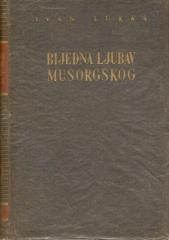
Bijedna ljubav Musorgskog

Bijedna ljubav Musorgskog

Ivan Lukaš

Ivan Lukaš's novel depicts the tragic love story of the great Russian composer Modest Mussorgsky. The novel follows his unrequited love, artistic struggle, alcoholism, and decline in 19th-century imperial Russia.

Savremena biblioteka, 1940.
Croatian. Latin alphabet. Hardcover with dust jacket.
9.24
Džingis-kan

Džingis-kan

Vasilij Jan

Vasily Yan's novel Genghis Khan depicts the rise of the Mongol leader Temujin, from childhood in the steppes to the creation of the largest empire in the world, highlighting his courage, cruelty, and relentless will to power.

Rad, 1988.
Serbian. Latin alphabet. Hardcover.
9.78