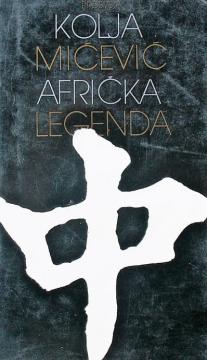
Afrička legenda

Afrička legenda

Kolja Mićević

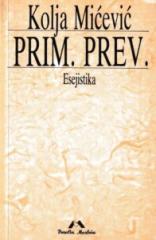
Kolja Mićević, a poet and translator of great reputation, created an unspecified genre, but challenging and beautifully written essayistic prose in which he talks about his spiritual, intellectual and life experiences.

One of the first peculiarities of this prose is the doubling of the narrator, the "subject" of the prose into two equal and often simultaneous voices, one of which is designated as "I" and the other as "Kolja Mićević, translator". The first voice narrates love and all other experiences that happen to the subject in Paris and on trips to France and Africa; the second, which is really difficult to separate from the first, tells the story of his intellectual and spiritual adventures, which the translator enters into when he tries to convey, translate into his native language, a poetic statement created in a foreign language. In other words, Kolja Mičevič tells about the adventure that happens when thought and experience, poetically shaped in the matter of one language, lose their basic linguistic form and replace it with another. With this continuous interweaving of different experiences, Micevič achieved an unusual and attractive combination of private and non-private. personal and literary.

Dimensions
21 x 14 cm
Pages
221
Publisher
Prosveta, Beograd, 1982.
 
Latin alphabet. Paperback with dust jacket.
Language: Serbian.

One copy is available

Condition:Used, very good condition
 

Are you interested in another book? You can search the offer using our search engine or browse books by category.

You may also be interested in these titles

Prim. prev.

Prim. prev.

Kolja Mićević
Veselin Masleša, 1989.
Serbian. Latin alphabet. Paperback.
4.99
Biljke učiteljice: jedan put izlječenja - pusti da se dogodi

Biljke učiteljice: jedan put izlječenja - pusti da se dogodi

Josep Vila i Tronchoni

Since Castaneda's books written more than forty years ago, no story has appeared that introduces us to the shamanic world with such power and truth as this book.

Sipar, 2013.
Croatian. Latin alphabet. Paperback.
12.54
Pismo nerođenom djetetu

Pismo nerođenom djetetu

Oriana Fallaci

One of the most moving and courageous works of world literature of the 20th century. Written as a long monologue by a pregnant woman (Fallaci herself), the book is at once an intimate confession, a feminist manifesto, and a philosophical confrontation wit

Znanje, 2009.
Croatian. Latin alphabet. Paperback.
4.56
Zarobljeni um

Zarobljeni um

Czesław Miłosz

The Captive Mind is a book published in France in 1953 by Czesław Miłosz, shortly after he was granted political asylum in Paris due to his conflict with the communist authorities in Poland, which was then under the control of the USSR.

BIGZ, 1987.
Serbian. Latin alphabet. Hardcover with dust jacket.
7.28 - 11.488.61
Tin bez vina: Dnevnički zapisi, feljtoni i članci o ´kralju boema´ (i oko njega)

Tin bez vina: Dnevnički zapisi, feljtoni i članci o ´kralju boema´ (i oko njega)

Vladimir Rem

A collection of diary entries, feuilletons and articles by Vladimir Rem dedicated to Tin Ujević. Rem writes in this book out of his personal fascination with Tin – his life, artistic path, bohemian habits, internal struggles and social influence.

Radničko sveučilište Nada Sremec, 1981.
Croatian. Latin alphabet. Paperback.
4.26
Dijamantni faraon

Dijamantni faraon

Vesna Krmpotić

After so many books and so many journeys (as if books weren't journeys!), after all collections of poems, narratives, essays and other titles, Diamond Pharaoh is revealed as one of Vesna Krmpotić's trademarks.

V.B.Z, 2002.
Croatian. Latin alphabet. Hardcover.
7.42